The CLARITY Act is a major U.S. crypto legislation intended to end long-standing regulatory ambiguity by categorizing digital assets like Bitcoin, Ethereum, and XRP into defined legal buckets and specifying which regulator oversees each category. Under the bill:
Lawmakers seek to eliminate decades of cross enforcement with an official statutory system. The proposal classifies digital assets into well-defined categories of regulations.
The tokens that run on decentralized networks that are decent enough would be considered as digital commodities. This would mainly be under the jurisdiction of the Commodity Futures Trading Commission.
Assets that are designed as investment contracts would be under the supervision of the Securities and Exchange Commission. The difference aims to terminate decades of confusion on the classification of tokens.
Negotiations are said to have helped to reduce previous differences that had stalled the progress. According to JPMorgan analysts, there are still only a couple of issues to be resolved.
BREAKING: JPMorgan says the Crypto Market Structure Bill is close to completion.
Contentious issues have been narrowed down from over a dozen to just 2-3. Stablecoin regulation is now reportedly in a good place.
The bill must clear the Senate Banking Committee by mid May to… pic.twitter.com/qPL5e838EN
— Bull Theory (@BullTheoryio) April 17, 2026
Final negotiations are still influenced by stablecoin yield rules and authority of the different agencies. Nevertheless, legislators seem to be on the brink of agreement more than ever before.
Why CLARITY Act Matters for XRP Holders
Regulatory clarity has been a constant worry to the investors of XRP. That uncertainty was heightened by the protracted legal wrangling between Ripple Labs and the SEC.
Despite a partial clarity provided by courts on the sale of XRP, there is still ambiguity. Institutional actors tend to be cautious against uncertainties concerning regulatory issues.
Should it become law, the Digital Bill Act may make XRP a formal definition of a digital commodity. This kind of classification would greatly lower the risk of enforcement in the future.
Proper identification can also enhance investor trust. There is usually a need to give a defined regulatory treatment to professional asset managers prior to capital allocation.
Surveys of the industry indicate that compliance uncertainty will deter institutional exposure to some tokens. A legal framework would foster a wider inclusion of the portfolios.
The bill may also have an impact on XRP adoption because of the custody provisions. Banks may or may not be able to store and provide digital commodities without hesitation by the regulators.
The latter development has the potential to increase cross-border payment applications related to XRP infrastructure. Before financial institutions can roll out blockchain tools, there is a solid legal foundation that is necessary.
Current Legislative Reality and Risks
The measure has been passed by the House of Representatives. It now has to go through committee and floor consideration in the Senate.
JPMorgan analysts feel that things are moving towards a decisive stage. Controversial issues have allegedly become a few as opposed to numerous conflicts.
Stablecoin regulation is said to be nearing acceptable compromise language. The bill has to pass through the Senate Banking Committee by the middle of May.
The inability to pass a floor vote before Memorial Day may postpone action considerably. Senator Moreno has cautioned that delay can make the consideration to 2027.
Such a schedule puts a sense of urgency on current talks. Political processes can have an impact on the ultimate amendments and details of implementation.
Bottom Line for XRP Holders
The CLARITY Act will be a potentially groundbreaking policy change to the holders of XRP. Well-defined commodity status may help to minimize litigation risk and increase institutional involvement.
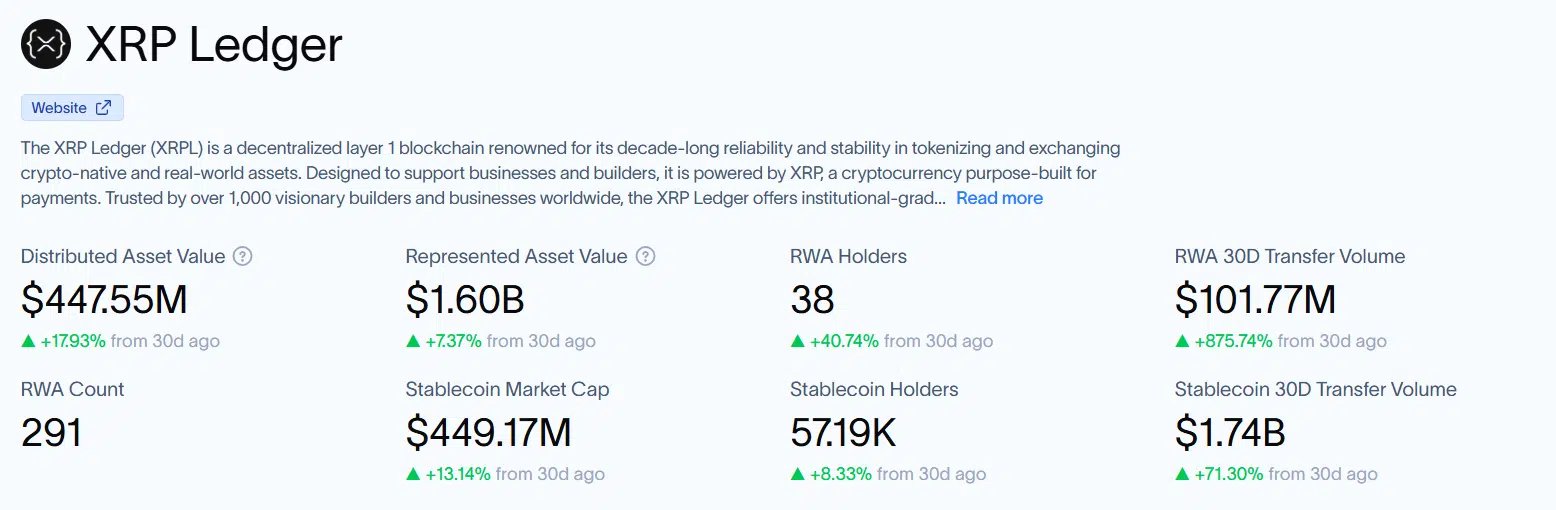
The activity of XRP holder stablecoin is gaining momentum with tokenized real-world asset measures recording a meaningful monthly increase. The volume of RWA transferred on the XRP Ledger increased by 875% in 30 days, to $101.7 million.
Distributed asset value increased to $447.55 million, and represented asset increased to 1.60 billion. The total RWA amount is almost $2.5 billion this year. The capitalization of the stablecoin market was 449.17 million, and 30-day transfers amounted to 1.74 billion.

Clarity of custody can be an incentive to banks to adopt XRP as part of payment infrastructure. Increased engagement may facilitate the adoption stories of the long term.
Nonetheless, timelines and ultimate language are crucial variables in legislation. Investors are advised to keep an eye on Senate developments as debates go on.
Frequently Asked Questions (FAQs)
It separates decentralized digital commodities from securities-like investment contracts under federal law.
The Securities and Exchange Commission would continue regulating securities-based tokens and investment contracts.
Source: https://coingape.com/trending/what-xrp-holders-should-know-about-the-clarity-act-right-now/