

How upgrade gaps enabled a coordinated attack
Attention now shifts to coordination gaps, with insights from Alex Shevchenko suggesting the exploit was likely premeditated rather than accidental. The attacker prepared to swap LTC into Ethereum [ETH] using an address funded 38 hours earlier from Binance – A sign of prior positioning around the MWEB flaw.
Block intervals stretched beyond the 2.5-minute target, sustaining a 13-block divergence for over three hours. Once the DoS eased, updated nodes restored consensus, confirming partial upgrade coverage.
Community reaction added pressure ttoo, as Solana [SOL] accounts resurfaced past Litecoin criticism over downtime, highlighting the irony of the event. This back-and-forth reflected broader sentiment shifts, one where reliability narratives quickly reverse under stress.


Externally, protocols like NEAR Intents faced about $600,000 exposure, showing how coordination gaps extend risk beyond the chain.
Recovery update clarifies containment and fixes
Litecoin’s recovery phase becomes clearer through the updates released, which outline how the network moved from disruption to stability.
The update confirmed a 13-block reorganization, one that removed invalid MWEB transactions while unaffected transfers remained intact. This reassured users about fund safety. As the network re-converged, no prolonged hashpower split emerged, showing consensus quickly returned to a single canonical state.

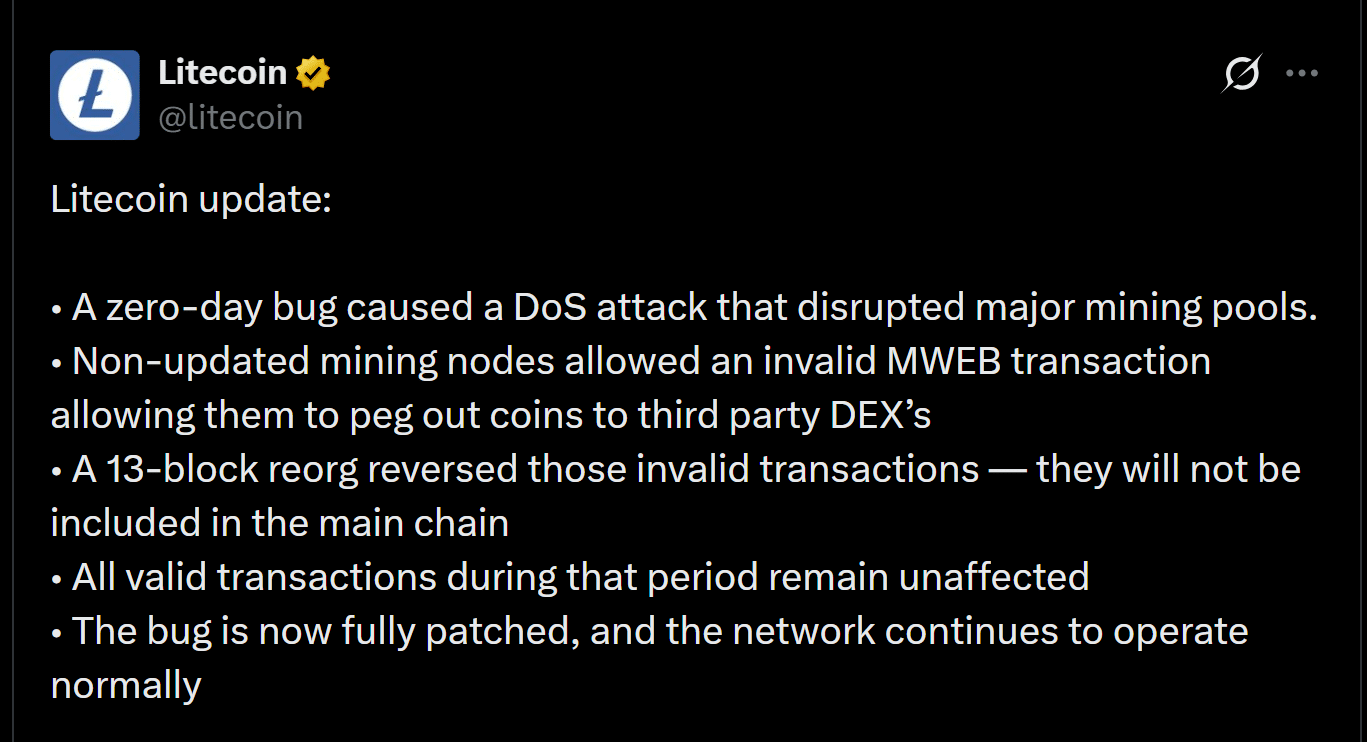
The update also detailed targeted fixes, including stricter validation checks and safeguards against malformed transactions, which directly addressed the exploit path. As these changes rolled out, node behavior aligned more consistently, reducing divergence risk.
This response is evidence that the failure was contained in duration. However, it also highlights how coordination delays can still expose short-term vulnerabilities.
Final Summary
- Litecoin restored consensus after a 13-block reorg, containing the exploit.
Source: https://ambcrypto.com/how-litecoins-13-block-reorg-exposed-fragile-coordination-in-network-upgrades/