New York Federal Reserve President John Williams has signaled that he is unlikely to support a Fed rate cut at the upcoming April FOMC meeting. This came as he warned that the effects of the U.S.-Iran war are already playing out, with higher energy prices putting pressure on inflation.
John Williams Signals Opposition To Fed Rate Cuts Right Now
In remarks at a New York event, the Fed president noted that the Iran war has presented an unusual set of circumstances, but that the current stance on monetary policy puts them in a good position to balance the risks to their inflation and maximum employment goals. He pointed out that this was what influenced the decision to hold rates steady at the March FOMC meeting.
This suggests that the Fed president, a permanent voting FOMC member, is unlikely to support a Fed rate cut at the April FOMC meeting. Williams stated that the economic outlook remains highly uncertain, particularly due to the effects of the U.S.-Iran war.
It is worth noting that the March FOMC minutes showed that most Fed officials believe that the Iran war poses a risk to both inflation and the labor market. As such, they indicated that they were still open to further Fed rate cuts if they begin to see signs of weakness.
Williams said he anticipates the employment rate will remain within its recent range of 4.25% and 4.5%. At the same time, he expects overall inflation to come in between 2.75% and 3% this year, reflecting the effects of higher energy prices. The Fed president added that inflation will reach their 2% target in 2027 as the effects of tariffs and energy prices fade.
Effect Of The Iran War Already Playing Out
Williams warned that the U.S.-Iran war could also result in a large supply shock with pronounced effects, raising inflation at the same time and dampening economic activity. He warned that this has to play out already, which is why he may be cautious about a Fed rate cut at the moment.
“While the data have not pointed to significant broad-based supply-chain bottlenecks yet, we are seeing increasing disruptions related to the supply of energy and related goods,” he said. The Fed president added that not only are elevated energy prices showing up in the rising cost of fuel, but there are also pass-through costs in the form of higher prices for goods and services.
It is worth noting that March PPI inflation rose to 4%, well above the Fed’s 2% target. With inflation trending higher, market participants expect the FOMC to hold rates steady rather than make a Fed rate cut at this month’s meeting.
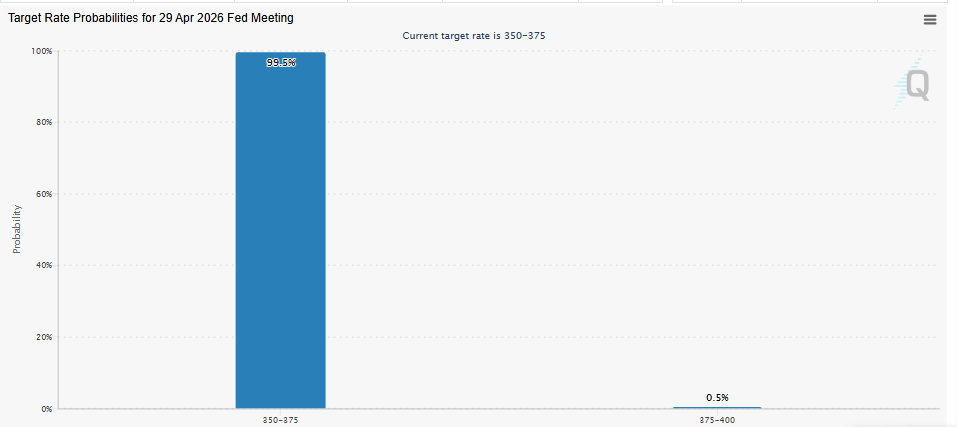
CME FedWatch data shows a 99.5% chance of the Fed holding rates steady at this April FOMC meeting. Meanwhile, crypto traders do not expect the Fed to lower rates until the October FOMC meeting, according to Polymarket data.