- India’s crypto market could grow 4.7x from $3.04B in 2025 to $14.21B by 2034.
- India ranked No. 1 in 2025 across retail, CeFi, DeFi, and institutional crypto activity.
- India taxes VDA gains at 30%, while qualifying transfers face a 1% TDS mechanism.
India’s crypto sector presents an unusual contradiction: adoption is accelerating even as taxation and compliance rules continue creating significant friction for traders. Market research and business consulting firm IMARC estimates the Indian crypto market could expand from about $3.04 billion in 2025 to $14.21 billion by 2034.
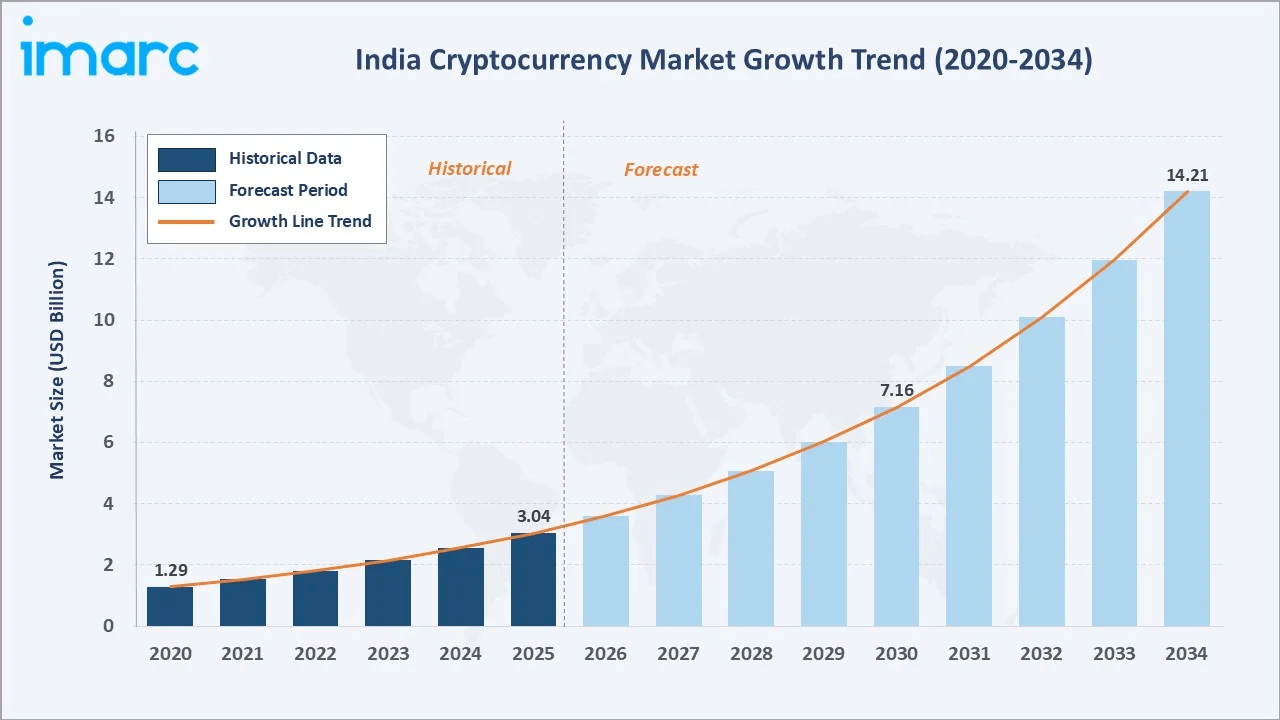
Source: IMARC
That represents roughly 4.7 times the estimated 2025 market size. However, it does not mean Indians are simply expected to buy five times more cryptocurrency. The forecast covers a broader ecosystem including exchanges, payments, remittances, wallets, blockchain software, infrastructure, and transaction services.
Consequently, the central question is not whether crypto trading will increase. It’s that the parts of India’s digital-asset economy are supporting growth despite restrictive conditions.
What Is Driving India’s Crypto Market Toward $14.2B by 2034
Available data points toward broad adoption and infrastructure development rather than domestic speculative trading alone. Chainalysis ranked India first in its 2025 Global Crypto Adoption Index. More importantly, the country ranked first across retail, CeFi, DeFi, and institutional activity.
India’s on-chain value also increased by about 99% year over year during the 12 months through June 2025. Meanwhile, crypto transaction volume across Asia-Pacific increased by 69% to $2.36 trillion during the broader period, with India among the markets supporting that expansion.
Together, those figures show participation extending across different user groups and transaction types. IMARC’s market segmentation further supports that interpretation, with software accounting for 56.07% of its estimated 2025 market.
That share indicates that a substantial portion of measured activity already extends beyond direct cryptocurrency trading.
Retail, DeFi and Institutional Demand Broaden India’s Growth
India’s established digital-finance ecosystem provides another foundation for adoption, although UPI itself should not be considered a direct crypto-growth mechanism. Instead, widespread digital payments demonstrate familiarity with digital financial services and support a fintech environment where new financial products can gain users.
Meanwhile, participation extends from smaller retail users to DeFi and institutional-sized transactions. For investors, that distinction matters as the $14.21 billion projection measures a broader industry rather than forecasting cryptocurrency prices.
Exchanges, wallets, software, compliance services, payments infrastructure, and other businesses can therefore contribute to market expansion without requiring equivalent growth in domestic trading volumes.
30% Crypto Tax and 1% TDS Push Trading Activity Offshore
However, India’s tax framework remains one of the clearest constraints on active cryptocurrency trading. Virtual digital asset gains are taxed at 30%, alongside applicable surcharges and cesses. Qualifying VDA transfers are also subject to a 1% TDS mechanism.
For frequent traders, that structure can create additional cash-flow pressure as deductions apply to qualifying transactions rather than only profitable activity. As a result, Esya Centre research found that the regime contributed to Indian crypto activity shifting toward offshore platforms.
Even so, high national adoption and weaker domestic exchange activity can exist simultaneously. Taxation can influence where Indians trade without necessarily eliminating demand for crypto assets or related services.
Compliance Expands as India Still Lacks Full Crypto Rules
India has also tightened oversight without establishing a comprehensive crypto market framework. Virtual digital asset service providers entered the country’s anti-money-laundering regime in 2023.
By October 2025, 50 providers had registered with FIU-IND. Authorities also continued enforcement against offshore platforms serving Indian users without registration.
However, a July 2026 parliamentary finance committee discussion confirmed crypto remains largely unregulated beyond taxation, AML rules, and reporting requirements. As a result, businesses face growing compliance obligations while broader rules governing the asset class remain limited.
The India crypto market growth story therefore rests on a wider base than trading alone. Retail adoption, DeFi participation, institutional activity, software, and infrastructure are expanding even as taxation pushes some trading offshore.
That combination explains how India can retain its adoption lead while still operating under restrictive tax and compliance conditions.
Related: Binance Gold Options Take on MCX: Can Indian Traders Get Better Liquidity Than MCX?
Disclaimer: The information presented in this article is for informational and educational purposes only. The article does not constitute financial advice or advice of any kind. Coin Edition is not responsible for any losses incurred as a result of the utilization of content, products, or services mentioned. Readers are advised to exercise caution before taking any action related to the company.