
 
 
Five years after the euphoric 2021 bull run, Bitcoin’s on-chain data paints a far more subdued picture. According to leading analytics firm Santiment, network activity has contracted significantly since February 2021.

Unique BTC addresses participating in transactions have fallen 42%, while new address creation has dropped 47% over the same period.
Well, the sharp decline signals a clear slowdown in network growth and user engagement compared to the explosive expansion that characterized the last cycle.
Furthermore, the widening gap between price and real utility is hard to dismiss. In 2025, market capitalizations climbed toward new highs even as Bitcoin’s on-chain activity steadily declined.
That imbalance, rising valuations alongside weakening network usage, marks a classic bearish divergence, signaling that price momentum may be outpacing underlying fundamentals.

 
Conversely, on-chain data suggests Bitcoin’s next confirmed bull phase may only begin after a period of maximum stress. Analysts are closely watching the Long-Term Holder Net Unrealized Profit and Loss (NUPL), a metric that tracks the average unrealized gains or losses of the most resilient investors.
Currently at 0.36, NUPL shows long-term holders remain in aggregate profit, implying that true capitulation, often a precursor to major trend reversals, has yet to occur.
Bitcoin’s Path to a Durable Rally Hinges on Network Growth and User Participation
For a sustainable long-term relief rally to take shape, on-chain metrics like active addresses and network growth must turn higher.
Rising user participation would signal that new capital is backed by real adoption, creating a far stronger, more durable foundation for upside.
Altcoins, however, remain closely linked to Bitcoin’s trajectory. While individual tokens can surge on project-specific catalysts and accelerate network activity, broader market confidence still hinges on Bitcoin showing structural strength.
A rebound in BTC utility would likely inject renewed momentum across the entire crypto ecosystem.
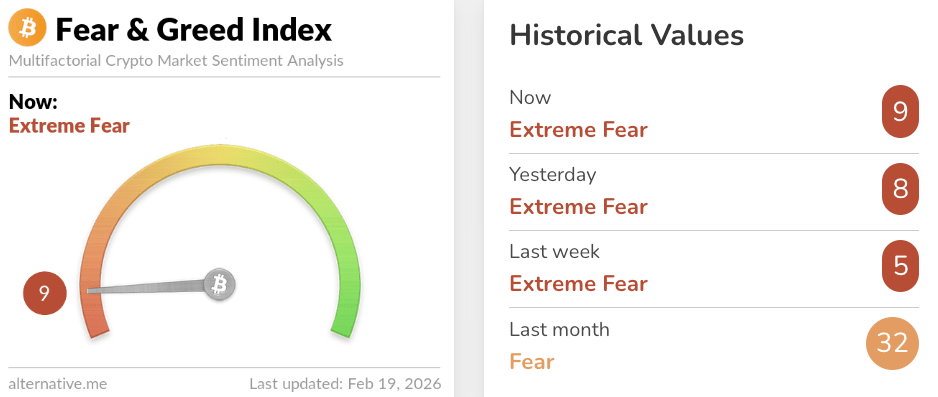
Sentiment remains deeply fragile. The widely watched Crypto Fear & Greed Index is still lodged in “Extreme Fear,” even as Bitcoin rebounds from its early February lows near $60,000.
At the time of writing, Bitcoin trades around $64,401, according to CoinGecko, still down roughly 24% year-to-date.
Any rally toward the $72,000–$76,000 range may become a major bull trap rather than the start of a sustained breakout.
Therefore, on-chain data reinforces caution because price stabilization alone does not signal recovery. A genuine structural reversal will require renewed capital inflows, rising network activity, and a decisive break from the bearish divergence that has quietly shaped Bitcoin’s 2025 trajectory.
Source: https://zycrypto.com/bitcoin-on-ice-network-activity-sees-50-drop-since-2021-fear-at-full-throttle/