Despite Nvidia’s (NASDAQ: NVDA) $4.3 trillion growth since late 2022 and a history of beating analyst forecasts with its earnings reports, investing in NVDA stock ahead of the filings has become a fraught affair.
Examining the equity’s performance through 2025 shows that the semiconductor giant experienced a pullback following the February 26, August 27, and November 19 releases and rallied after the report unveiled on May 28.
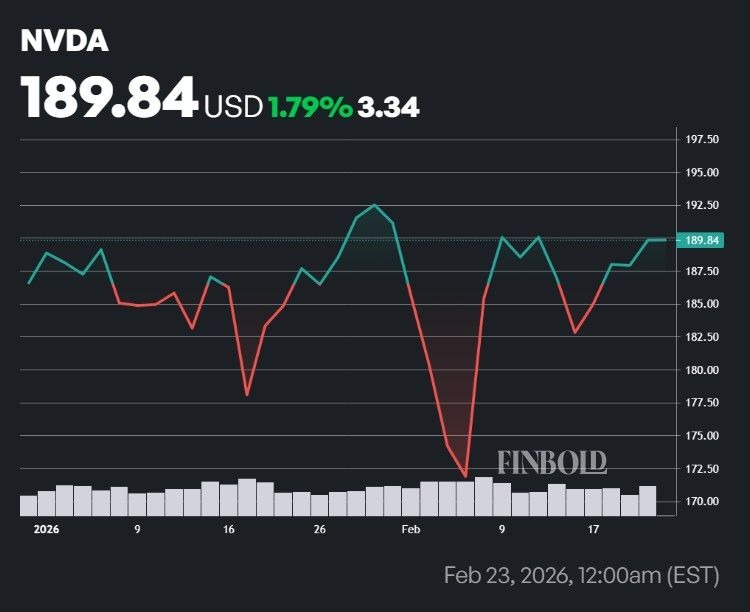
The situation ahead of the upcoming February 25, 2026, earnings report appears likewise uncertain, and NVDA shares might be equally likely to rally and plummet, especially given that they have effectively traded flat since New Year’s Day.
Why Nvidia stock is a ‘Buy’ before February 25 earnings
To begin with, institutional optimism for the blue-chip chipmaker remains high amidst strong revenue growth, a strong cash position and portfolio, and an extensive network of corporate deals valued at, almost as a rule of thumb, in the hundreds of billions.
Wall Street, for its part, considers Nvidia stock a ‘Strong Buy’ overall and forecasts a 39.94% rally to $265.63 in the coming 12 months, per the data Finbold retrieved from TipRanks on February 23.

Additionally, the company’s overall position is strengthened by its technological dominance, which appears unchallenged. On the consumer side, for example, Nvidia’s hardware has been consistently outperforming competitors in benchmark tests – a fact that has, arguably, led to its dominance among corporate clients.
Similarly, the semiconductor giant appears confident in its partnerships as it is reportedly in the process of finalizing a $30 billion investment in OpenAI – a deal that is merely one part of Sam Altman’s company’s drive to raise $100 billion at a staggering $830 billion valuation.
Why Nvidia stock is a ‘Sell’ ahead of February 25 earnings
Still, it is exactly the alleged $30 billion agreement that presents the first sign that something might be rotten in the state of artificial intelligence (AI).
Specifically, Nvidia unveiled in the second half of 2025 a $100 billion investment in OpenAI as part of a deal that had turned out to be far less binding than many outlets initially reported.
Indeed, the latest alleged agreement with the world’s most recognizable AI company appears to be a replacement for the since-vanished and much bigger investment.
Under the circumstances, both the reduced scale of the deal and the continued willingness to commit massive amounts of money might present significant risks for Nvidia investors.
At press time on February 23, 2026, the AI industry’s road to profitability, despite lofty future estimates, appears vague at best.
A large part of this uncertainty is owed to the fact that demand appears lacking – the impressive user figures represent a mix of organic growth, ‘AI Washing,’ enforced integration into systems such as the Windows OS, company-mandated usage, and many others – and the results of AI adoption are lackluster.
Additionally, it remains doubtful if artificial intelligence usage will keep pace with current numbers long-term, considering companies are heavily subsidising adoption. OpenAI itself reportedly estimated that it will lose $14 billion in 2026.
Why Nvidia stock might crash after next earnings report
Another potential headwind NVDA stock might face in the wake of its next earnings reports comes from customer concentration. In late August, reports indicated that only three clients accounted for approximately half of Nvidia’s income.
The top customer was responsible for a staggering 23%.
Such a setup could have dire consequences with regard to both the previous quarter and the guidance for the rest of 2026.
On the one hand, Microsoft (NASDAQ: MSFT) wiped nearly $400 billion in a single session once its otherwise-strong report revealed that about 45% of the company’s backlog is tied to OpenAI.
On the other hand, the 2026 memory shortage – the so-called ‘RAMageddon’ – has led Nvidia to consider reissuing older chips in lieu of the allegedly dropped new models in a move that might surrender consumer market share to competitors like Advanced Micro Devices (NASDAQ: AMD) or Intel (NASDAQ: INTC).
Coincidentally, the ‘RAMageddon’ is the result of a domino effect started by OpenAI’s attempts to hoard the yet-to-be-produced memory supply in 2026.
Featured image via Shutterstock
Source: https://finbold.com/is-nvidia-stock-a-buy-ahead-of-this-weeks-earnings/