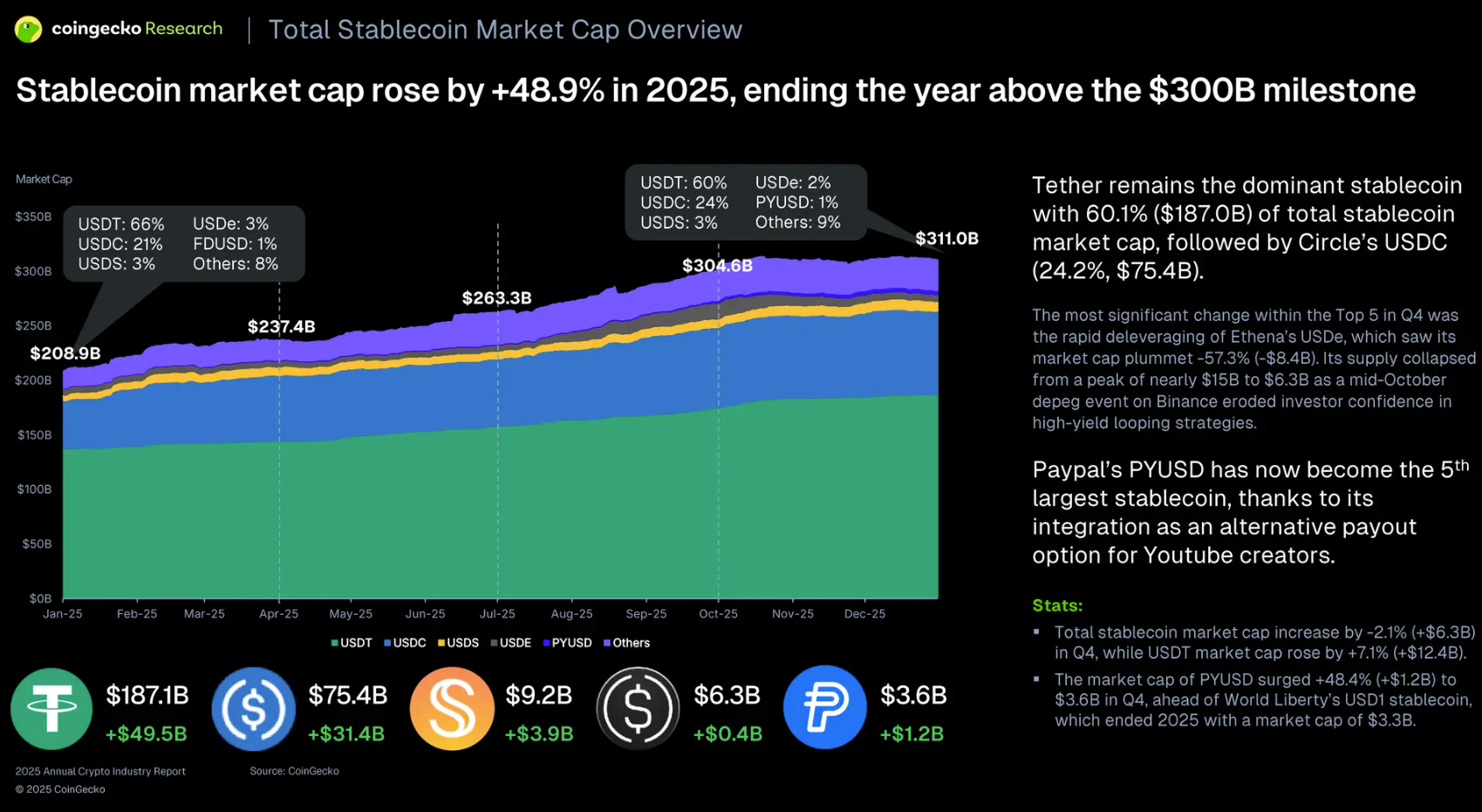
Tether made $5.2 billion in protocol revenue in 2025 mainly from interest on more than $135 billion of U.S. Treasury bills and reserve assets backing USDT, enabled by high Federal Reserve interest rates and its 60.1% share of the global stablecoin market.

This revenue was not driven by trading or transaction fees. It was driven by Tether acting as a large-scale holder of short-term U.S. government debt while issuing dollar-backed stablecoins that do not pay yield to users.
Why Tether’s $5.2B protocol revenue surged, and what is underneath
Tether’s revenue surge came from the same mechanism that powers traditional money market funds. For every USDT issued, Tether holds an equivalent dollar in reserve and invests that reserve into low-risk, interest-bearing assets such as U.S. Treasury bills and overnight repos.

In 2025, those instruments were yielding over 5 percent, turning stablecoin reserves into one of the most profitable pools of capital in global finance. With a circulating supply near $187 billion, Tether controlled one of the largest pools of investable dollars in the world.
Because it does not share interest with token holders, nearly all yield flowed directly to the issuer, creating extremely high net income per employee and pushing Tether’s projected profit toward $15 billion by the end of 2025.
Beyond interest income, Tether also generated billions in unrealized gains from Bitcoin and gold investments funded by excess reserves. This diversification strengthened its balance sheet and amplified its financial dominance within crypto.
How stablecoin issuers earn protocol revenue across Tron and Ethereum
Stablecoin issuers like Tether and Circle primarily earn money from reserve yields rather than from the blockchain networks on which their tokens circulate. Every USDT or USDC issued is backed by fiat or liquid assets that generate interest. The issuer keeps that interest while users only receive price stability.
While the revenue model is the same on every chain, Tron and Ethereum shape how stablecoins are used. Tron specializes in high-volume, low-value transactions such as remittances and exchange settlement. Ethereum attracts higher-value transfers used for decentralized finance, collateral, and institutional liquidity.
In 2025, Tron processed approximately 2.3 to 2.4 million USDT transactions per day, more than six times the volume of Ethereum. Ethereum, however, handled much larger transfers, with the average transaction roughly thirteen times the size of those on Tron.
Interest rates, Treasury yields, and market liquidity as drivers of 2025 protocol revenue
High U.S. interest rates were the dominant force behind stablecoin profitability in 2025. With Treasury yields near post-global financial crisis highs, issuers were able to invest more than $200 billion of combined reserves into short-term government debt yielding over 5 percent annually.
Tether alone held more than $135 billion in U.S. Treasuries, making it one of the largest non-government holders of U.S. debt. This generated over $10 billion in net profit, rivaling the earnings of major investment banks such as Goldman Sachs and Morgan Stanley.
Stablecoins also benefit from what Google classifies as “sticky liquidity” and “flight to quality.” During risk-off market conditions, investors move from volatile crypto assets into dollar-pegged stablecoins, expanding the reserve base even when prices fall.
MiCA in the European Union and United States oversight risks
What MiCA means for stablecoin reserves and interest income
MiCA explicitly bans stablecoin issuers from paying interest or any form of yield to token holders. However, it allows issuers to continue earning interest on their reserve assets as long as those reserves are held in low-risk, highly liquid instruments.
Under MiCA:
- Stablecoins must be fully backed one to one
- At least 30 percent of reserves must be in EU banks
- The rest can be in low-risk assets such as Treasury bills
- Large issuers face stricter requirements
Large stablecoin issuers may be required to hold up to 60 percent of reserves in banks, increasing compliance costs but improving systemic stability.
United States oversight: disclosures, custody, and money-market exposures
The U.S. GENIUS Act of 2025 formalized stablecoins as regulated payment instruments. It requires monthly public reserve disclosures, independent attestations, executive certification, and clear redemption procedures. Reserve assets must be held by qualified custodians and segregated from issuer funds.
Issuers are restricted to holding only high-quality, liquid assets such as cash, insured deposits, short-term U.S. Treasuries, and Treasury-backed repos. They are also prohibited from paying yield to stablecoin holders, reinforcing the model where all interest income accrues to the issuer.
Macro drivers: yields, Japan policy, ETF flows, and risk-off volatility
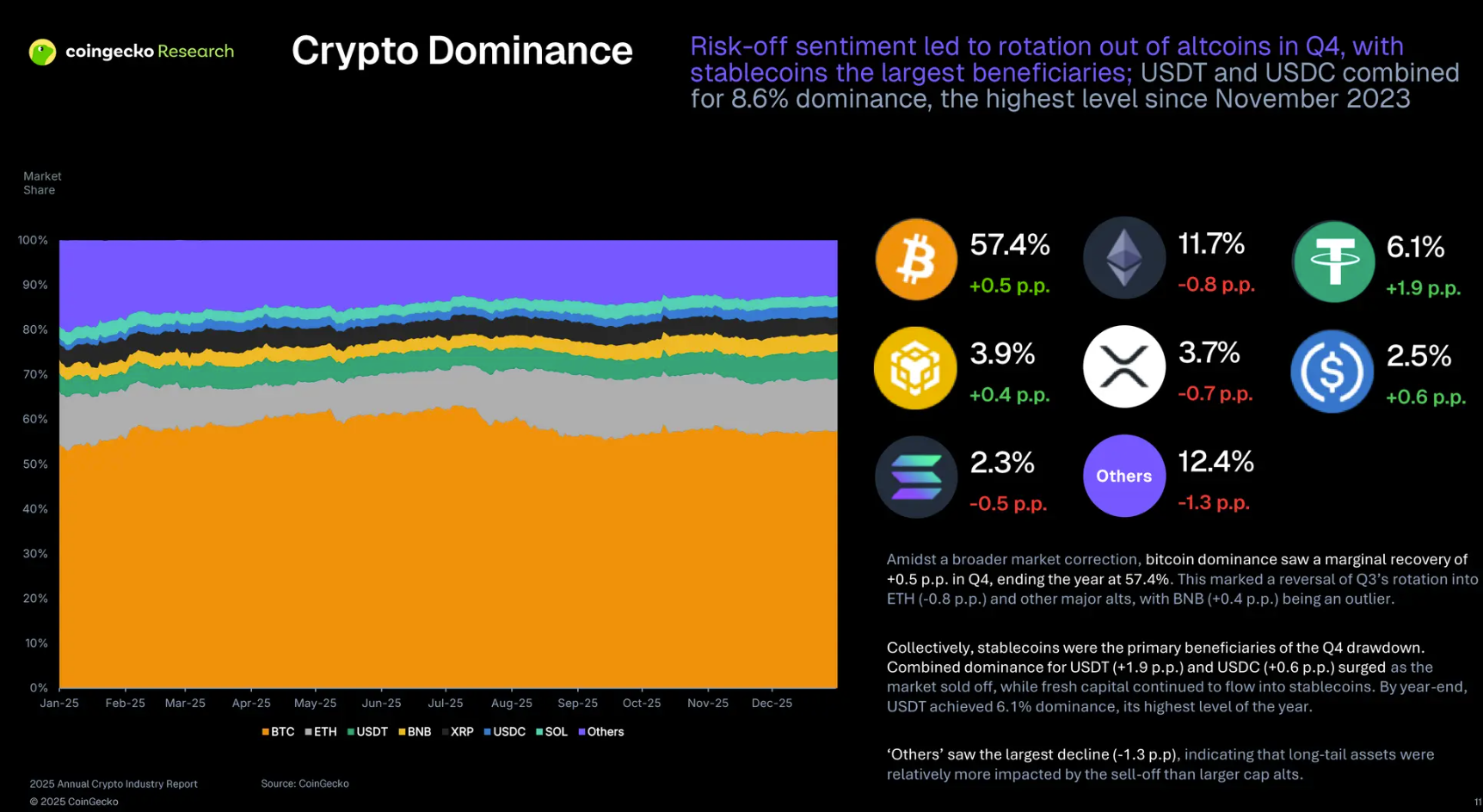
Global financial stress increased stablecoin demand rather than reducing it.
- High Federal Reserve interest rates above 5%
- Over $200B in stablecoin reserves earning yield
- Japan rate hikes causing risk-off rotations into USDT
- ETF inflows using stablecoins as capital parking
- Market crashes increasing flight to quality
Competitive landscape: networks, market share, and protocol revenue rankings
Tether’s USDT on Tron versus Ethereum
| Metric | Tron | Ethereum |
|---|---|---|
| USDT supply | Over $80B | About $80B |
| Daily transactions | 2.3–2.4M | ~6x lower |
| Avg transaction size | Small | ~13x larger |
| Primary use | Payments, remittances | DeFi, institutions |
| Revenue impact | High velocity | High liquidity |
Tron holds more than $80 billion in circulating USDT and accounts for over half of total USDT supply. It is optimized for fast, low-cost payments and is heavily used in emerging markets for remittances and exchange settlement.
Ethereum holds a similar amount but is used primarily for DeFi, institutional custody, and high-value transfers. Tron delivers transaction velocity, while Ethereum delivers capital concentration. Together, they maximize the reserve base that generates Tether’s interest income.
USDC and DAI positioning and MakerDAO reserve strategy
USDC targets regulatory compliance and institutional trust, backed by audited reserves and bank integrations. DAI targets decentralization and censorship resistance through over-collateralized crypto and real-world assets. MakerDAO increasingly uses tokenized U.S. Treasuries to generate yield that supports the Dai Savings Rate.
Quick Fact: BingX exchange is offering exclusive perks for new users and VIP traders.
Tether differs in that it retains all reserve income instead of distributing it to token holders, giving it a structural profit advantage over both USDC and DAI.
CoinGecko data considerations and comparability limits
CoinGecko calculates stablecoin prices using volume-weighted averages across exchanges and verifies circulating supply with issuers and blockchain data. Market capitalization is derived from price multiplied by verified supply.
However, comparing fiat-backed stablecoins such as USDT and USDC with crypto-backed stablecoins such as DAI requires caution due to different reserve models, multi-chain supply fragmentation, and varying levels of transparency.
| DISCLAIMER: The information on this website is provided as general market commentary and does not constitute investment advice. We encourage you to do your own research before investing. |