Strategy Executive Chairman Michael Saylor has said that quantum computing is not a threat to Bitcoin at the moment and called the narrative FUD. He further said that any meaningful danger would still be more than a decade away.
The Strategy executive chairman also attributed the price limit of Bitcoin to restricted access to bank credit. According to him, this indicates that liquidity, rather than quantum risks, was influencing prices. He further said that the traditional lending channels are not accessible to Bitcoin holders.
Michael Saylor Quantifies Bitcoin Quantum Threat as Distant
In a sit-down interview with Natalie Brunell in the Coin Stories podcast, Saylor discussed quantum risks in relation to Bitcoin. He stated that there is a general consensus among the cybersecurity community that it would still take more than a decade before it poses a meaningful threat. He added that there is also no agreement among these experts that a quantum risk will materialize at all.
Saylor put the quantum debate within the broader category of Bitcoin criticism that has failed manifest. He referenced examples such as block size wars, Chinese mining bans, and energy consumption arguments, adding that none of them brought the network down.
Michael Saylor also said that if there were any threat at all, the cryptographic system in Bitcoin would have further improved before quantum systems could attack the network on a practical level. His point was that the network can have enough time to make defensive improvements as necessary.
In contrast, CryptoQuant CEO, Ki Young Ju, has warned of a growing quantum threat to Bitcoin. He argued that the development of quantum computing can lead to a compromise of millions of BTC coins. He added that the magnitude of the possible risk needs to be discussed early, although it is not imminent.
Besides, on-chain analyst Willy Woo cautioned that quantum risk is capable of undermining the advantage of Bitcoin over gold. He stated that markets need to start considering the likelihood of the “Q Day.”
Why BTC Upside is Limited
Michael Saylor associated the Bitcoin price ceiling with the inaccessibility of conventional bank credit. He claimed that the majority of market players are unable to borrow against Bitcoin through regulated financial institutions.
He argued that equity investors are able to access borrowed funds from major banks, but Bitcoin holders are usually left with options such as high-interest loans.
Saylor also said that rehypothecation in crypto lending markets could lead to greater selling pressure on Bitcoin. Michael Saylor further said that the shift of derivatives trade to the regulated markets has mitigated radical swings in prices.
According to TradingView data, the BTC price has plunged below $65,000, down by almost 5% in the last 24 hours. The token has now dropped to its lowest point since the beginning of February. There were also mixed levels of price falls among altcoins and crypto stocks.
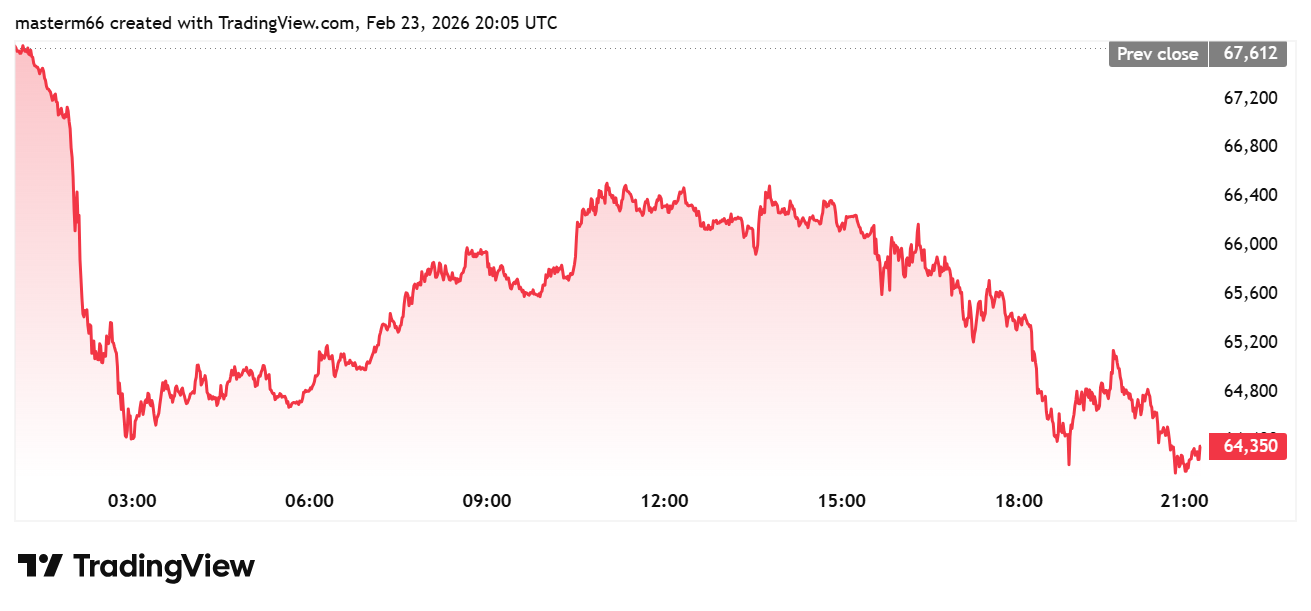

The crash occurred as traders responded to new tariff measures announced by President Trump. As a result, the fear and greed index has dropped to extreme fear levels.