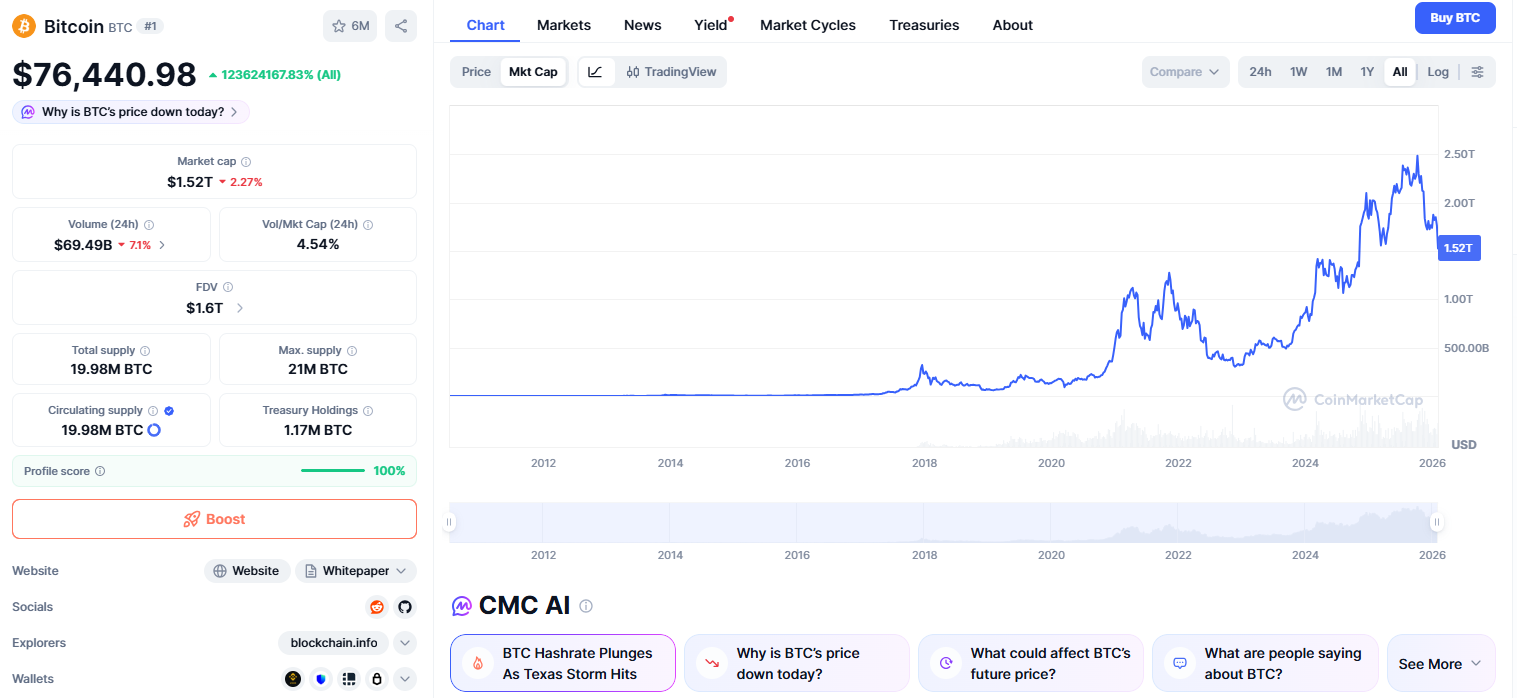
Bitcoin plunged below $80,000 and briefly traded near $75,700, erasing all year to date gains and marking the lowest level since April 2025. The breakdown was driven by legislative delays in the United States, collapsing technical structures, and intensifying macro and geopolitical stress.

Over $2.5 billion in leveraged long positions were liquidated within 24 hours, while ETF outflows, miner selling, and thin weekend liquidity amplified the selloff into a cascading market event. Altcoins suffered deeper drawdowns than Bitcoin as Solana, and memecoins lost momentum, confirming a full market wide shift to risk off positioning.
Why Bitcoin fell below $80K: legislation delays, technicals, macro tensions
Bitcoin traded above $80,000 multiple times in late January before collapsing to $75,766 on February 1, 2026. The move wiped out all 2026 gains and shifted market structure into a bearish regime.
In Washington, the U.S. Senate delayed the Crypto Market Structure Bill (FIT21) until at least 2026, while a partial government shutdown froze SEC operations, stalling ETF approvals and regulatory guidance. This removed institutional bid support just as leverage across crypto derivatives reached cycle highs.
Technically, once BTC lost $80,000, a liquidation cascade followed. Over $2.5 billion in long positions were wiped out in 24 hours.
U.S. spot Bitcoin ETFs recorded three consecutive months of net outflows, including a single day exceeding $800 million, while miners increased exchange inflows, raising sell pressure.
Macro forces intensified the selloff. Trump’s nomination of Kevin Warsh as Fed chair strengthened the U.S. dollar and lifted real-rate expectations, reducing Bitcoin’s appeal as a non-yield asset.
At the same time, escalating U.S.–Iran tensions triggered global risk aversion. Traders treated Bitcoin not as digital gold but as a liquidity source, selling it first during a thin weekend market.
Key levels: support and ~$80,000 resistance
As of February 2, 2026, Bitcoin was trading near $7̀5,431. Analysts identify $75,000 to $75,500 as the immediate structural floor. A breakdown opens the path to $74,000 to $74,400 liquidity zones, followed by the psychological $70,000 region.
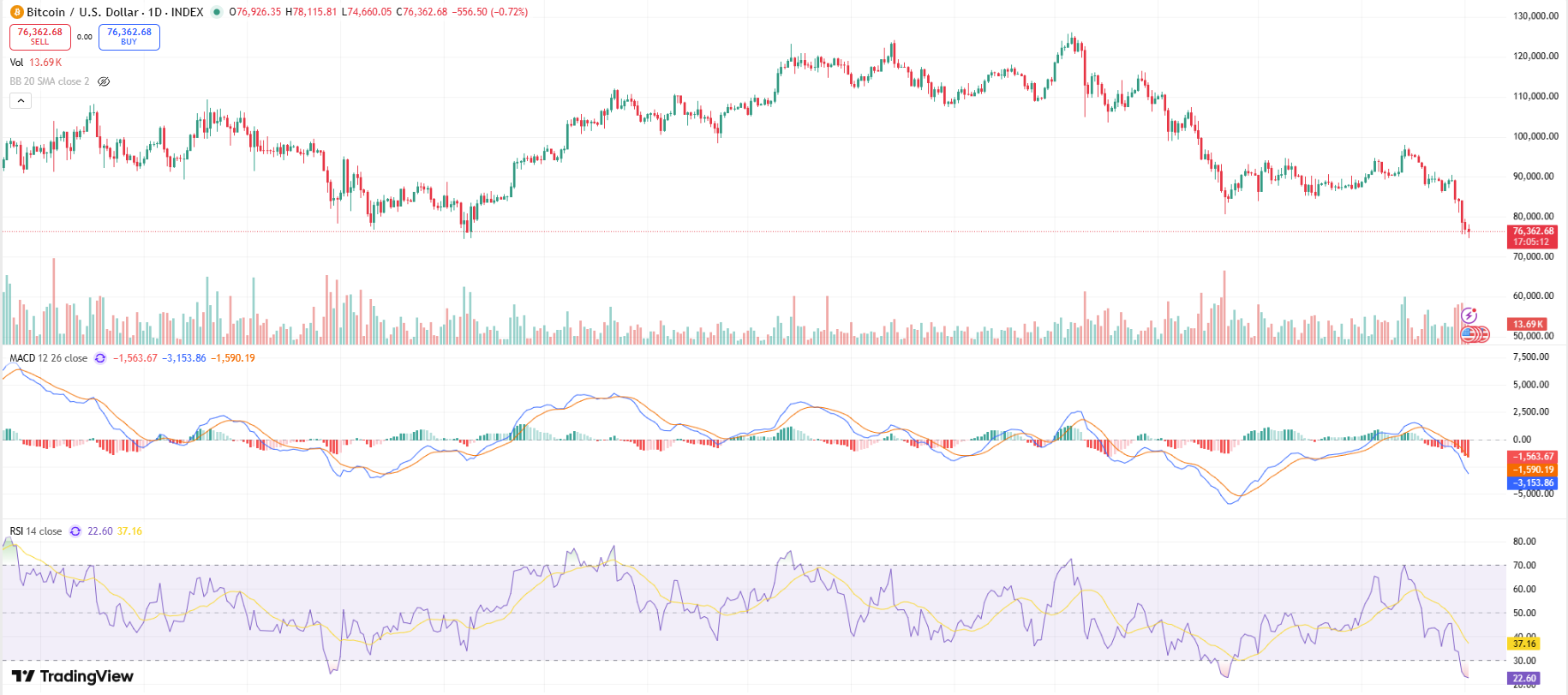
Resistance remains layered. The first ceiling lies at $78,500 to $79,200. Above that, the $80,000 to $80,700 zone is now the strongest technical barrier. A successful reclaim would shift momentum neutral, with $82,000 as the next upside test.
RSI at 22.47 indicates oversold conditions, suggesting potential short term rebounds. However, MACD remains deeply negative, confirming dominant selling pressure.
Market structure and derivatives: trading volume, liquidity conditions, liquidations, funding rates, MA/RSI
Bitcoin’s breakdown below $80,000 accelerated because the market was structurally fragile, overleveraged, and illiquid at the same time. Once key supports failed, forced liquidations and thin order books amplified selling pressure, turning a technical pullback into a cascading market-wide unwind.
Key structural signals behind the selloff
- Thin liquidity: Order book depth within ±2% is heavily skewed to sellers, with top liquidity near $500,000, allowing even small sell orders to push price sharply lower.
- Liquidation cascade: Between $2.2–$2.6 billion in derivatives positions were liquidated, affecting over 335,000 traders, creating a mechanical domino effect.
- Funding rate risk: Despite the crash, funding rates remain slightly positive, meaning long positions are still paying to hold, increasing the risk of another long squeeze if price fails to recover.
- Moving averages: Bitcoin is trading below both the 50-day and 200-day EMAs, confirming a bearish market structure rather than a short-term dip.
- RSI compression: RSI in the 33–36 range reflects panic selling and market stress, which historically aligns with capitulation phases, not sustainable trend reversals.
Altcoin breadth: Solana activity and market-wide moves in risk-off
SOL network throughput and fees as risk appetite barometer
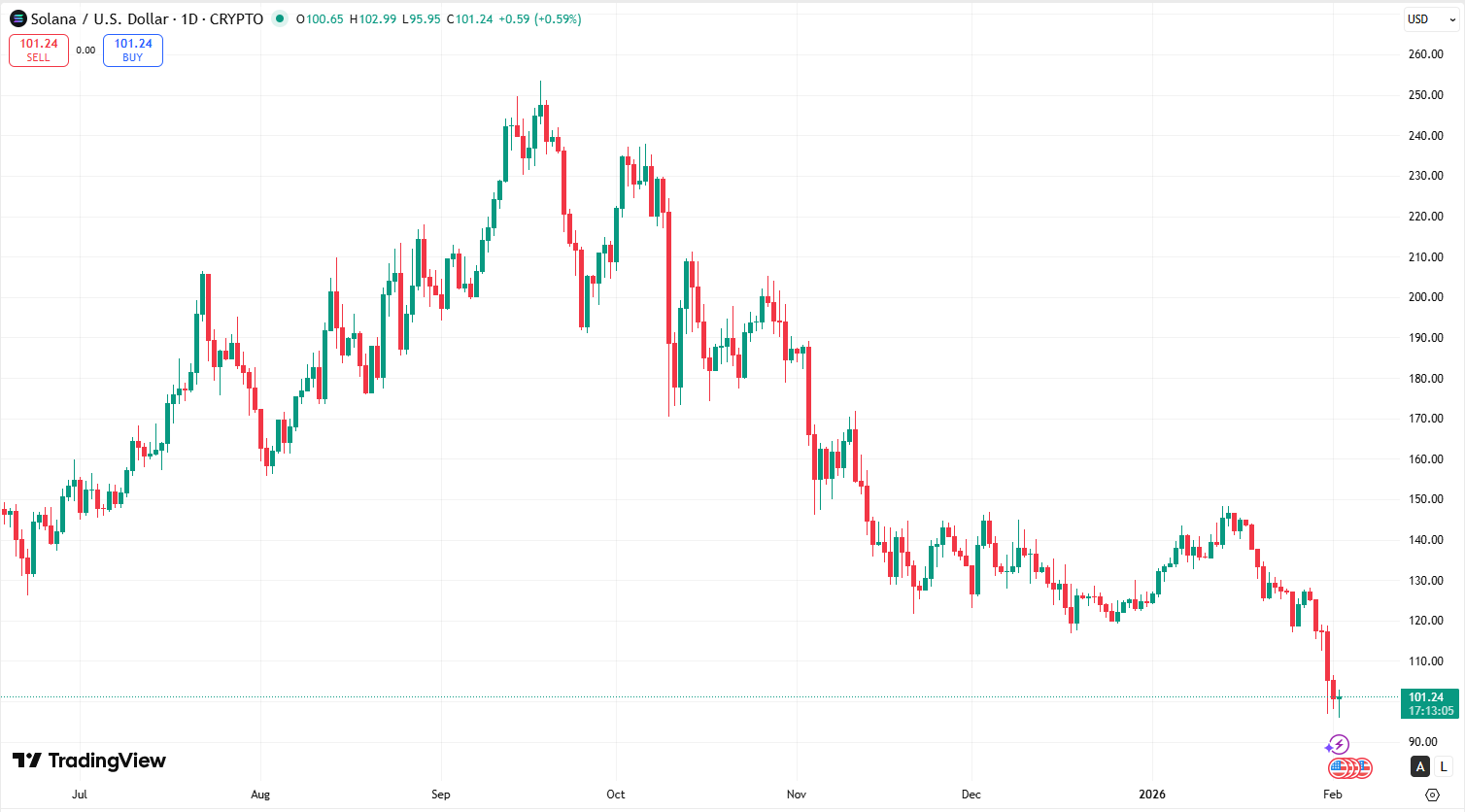
Solana has fallen nearly 25% from cycle highs. Memecoin issuance on Pump.fun collapsed as retail liquidity exited. Solana throughput dropped from over 3,000 TPS to significantly lower levels, while transaction fees declined sharply, reflecting a cooling speculative environment.
Breadth during selloffs: large-caps vs mid-caps; equities correlation
Top 100 altcoins recorded double digit losses. BTC dominance rose as capital rotated out of mid caps, which suffered 25 to 40% drawdowns due to thin liquidity. The advance decline ratio reached 15:1, confirming market wide capitulation.
Bitcoin correlation with Nasdaq surged to 0.75, indicating a global liquidity squeeze rather than an isolated crypto event.
Moving averages (MA) and RSI shifts across BTC, SOL, majors
SOL RSI fell to 30 to 32, ETH below its 100 day MA, and altcoin market RSI dropped to 28. These readings confirm a synchronized speculative unwind.
What to watch next: retests, signal shifts, flows, policy, macro risks
On-chain metrics and exchange flows: supply, realized profits, whales
Exchange inflows remain elevated as miners and short term holders sell. SPPR below 1.0 shows that most are realizing losses. A sustained recovery requires exchange outflows and renewed whale accumulation near $75,000.
Policy timeline: U.S. Congress, SEC oversight shifts, enforcement tone
Senate hearings on FIT21 are expected mid February. A government budget deal would reopen the SEC. Leadership changes and new ETF approvals could shift enforcement from punitive to structural regulation.
Macro and geopolitics: yields, Japan, safe-haven flows, volatility
If the U.S. 10Y yield remains above 4.5% and DXY breaks 105, Bitcoin will struggle. A BoJ rate hike could unwind carry trades and drain global liquidity. Rising gold prices and VIX above 25 signal sustained risk off conditions.
| DISCLAIMER: The information on this website is provided as general market commentary and does not constitute investment advice. We encourage you to do your own research before investing. |