Analog January is meeting Bitcoin at the custody layer as some investors seek exposure without screen time.
The digital-minimalism push, framed as “tech-low and slow living,” is landing as crypto returns to a volatility regime that makes constant checking expensive.

Livingetc reported that “Analog January” (sometimes shortened to “Janalog”) is a reset from compulsive micro-checking rather than a move off-grid, quoting productivity specialist Emily Austen in a piece published Jan. 7, 2026.
In parallel, markets swung through a liquidation cascade, with 24-hour liquidations at $874 million and Bitcoin peaking near $95,000 before reversing as major tokens opened lower.
The overlap between a “check less” cultural reset and a “move fast” trading tape is turning custody into a lifestyle variable.
Investors already have tools that reduce attention, such as index funds or ETF wrappers, but most crypto interfaces still nudge users toward prices, alerts, and leverage.
Bitcoin is unusual among widely traded assets because its low-touch mode is not a platform feature; it is a custody choice.
Holders can self-custody in cold storage, keep keys off connected devices, and verify ownership without maintaining a perpetual account relationship with a broker or exchange.
That makes it legible as an “anti-screen” store-of-value posture in a way that looks closer to a vault than an app.

What this means for adoption, culture, and the next phase of crypto infrastructure
ETF flows show the other side of the same behavior, reducing touchpoints by delegating custody and execution.
Spot Bitcoin ETFs saw $394.7 million of net outflows yesterday, while spot Ethereum ETFs recorded $4.64 million of net inflows.
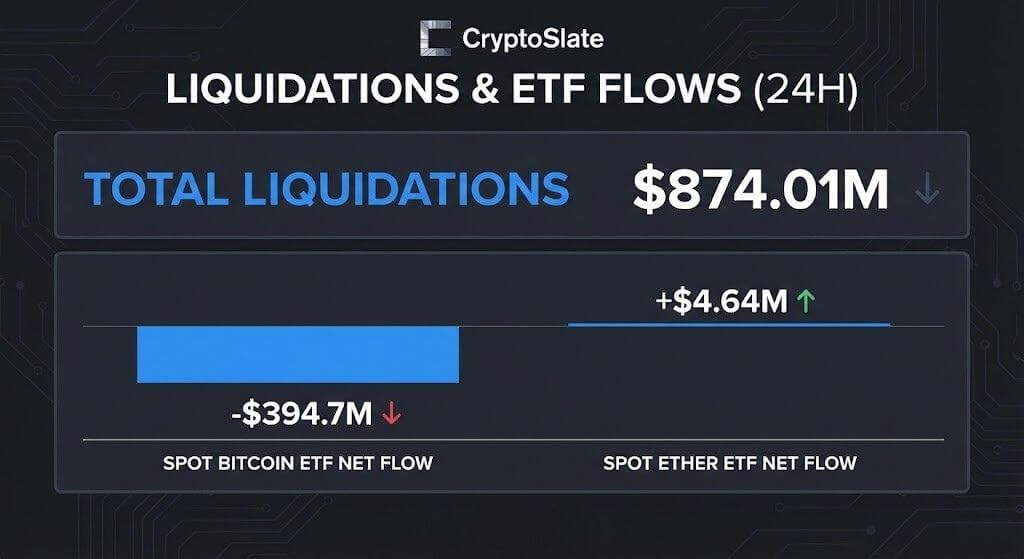
The figures do not map one-to-one to on-chain transfers, but they show that “set-and-forget” can mean convenience through regulated wrappers just as easily as sovereignty through keys.
They also show flows can pivot even during a culture moment built around stepping away from screens.
Hardware wallets sit at the center of the offline custody pathway, and the market is scaling beyond early-adopter cycles.
According to Mordor Intelligence, the hardware wallet market is valued at $0.56 billion in 2026, estimated at $0.72 billion by the end of the year, and forecast to reach $2.58 billion by 2031.
That implies a 29.05% compound annual growth rate from 2026 through 2031.
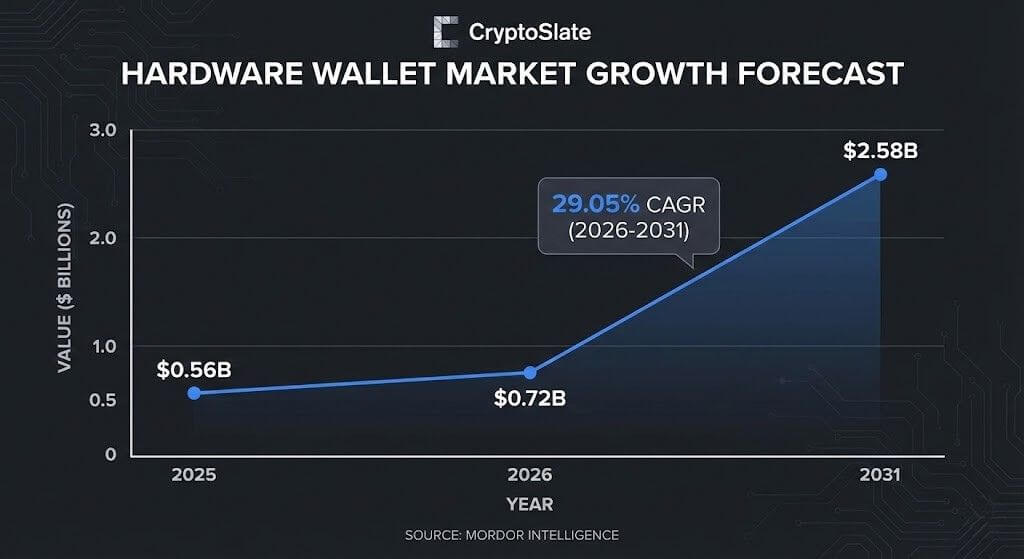
The trajectory suggests supply chains, retail distribution, and support infrastructure that can absorb demand bursts when volatility or security headlines push users toward cold storage, rather than constraining adoption to specialist circles.
| Metric | Figure | Timeframe |
|---|---|---|
| Liquidations | $874.01M | 24 hours |
| Spot Bitcoin ETF net flow | -$394.7M | Same window |
| Spot Ether ETF net flow | +$4.64M | Same window |
| Hardware wallet market | $0.72B | 2026 estimate |
| Hardware wallet market | $2.58B | 2031 forecast |
| Crypto stolen | $2.2B | H1 2025 |
| Thefts targeting individuals | 23% | H1 2025 |
Security is the other structural driver for going offline
The Financial Times reported demand for secure crypto devices as hacks hit record levels, citing Chainalysis data that $2.2 billion was stolen in the first half of 2025, with 23% of thefts targeting individual wallets.
The report also noted that Ledger’s revenue reached “triple-digit millions” in 2025.
Beyond hacks and phishing, crypto holders are increasingly facing real-world violence designed to bypass even the strongest wallet security. These incidents, often referred to as “$5 wrench attacks,” involve criminals using threats, kidnapping, home invasions, or torture to force victims to hand over seed phrases or authorize on-chain transfers, which are typically irreversible once sent.
CryptoSlate has reported on a growing pattern of attacks across 2024 and 2025, including cases where victims were specifically targeted after their identities, addresses, or holdings were exposed through data leaks or doxxing, and even situations where attackers posed as delivery workers to gain access.
The rise in these crimes is pushing some high-net-worth investors to adopt more aggressive personal security measures and rethink how publicly they discuss crypto wealth, because in the self-custody era, the weakest link is often no longer the code, but the person holding the keys.
For this reason, wallets that allow multiple accounts with separate PIN codes are preferred, as they allow holders to create “distress” or “honey-pot” wallets to avoid losing everything in the event of a physical attack. Users split holdings across distinct pin codes to be compliant with attackers without giving the keys to every sat.

That backdrop turns self-custody from an identity choice into an operational choice because the attack surface for individuals sits at the intersection of always-connected devices, phishing vectors, and hurried transaction signing.
Whether the analog mood is converting into custody behavior can be tracked with public indicators that move faster than quarterly surveys.
Google’s Trends’ Trending Now experience uses a forecasting engine that refreshes every 10 minutes, allowing short-window comparisons between terms tied to digital fatigue (“Analog January,” “digital detox”) and terms tied to offline security (“hardware wallet,” “cold storage,” “seed phrase”).
Past the attention layer, intent can be watched through exchange-balance proxies
CryptoQuant’s Exchange Reserve is defined as the total coins held on exchanges, a series market participants often use as a proxy for potential sell-side inventory and post-shock transfers into longer-term storage.
Volatility can also be anchored in a forward-looking measure rather than spot swings.
According to CF Benchmarks, the CME CF Bitcoin Volatility Index (BVX) is a 30-day constant-maturity implied volatility measure derived from CME Bitcoin and Micro Bitcoin options.
When implied volatility reprices, hedging costs, and the day-to-day friction of monitoring positions reprice with it, which is where a “check less” habit and “hold offline” tools can converge into observable shifts in custody and flow.
Bitcoin fits the ‘Analog January’ mindset more cleanly than most large-cap tokens because its store-of-value framing maps onto cold storage workflows.
Ethereum can still see the same custody reflex, especially for holders who want safer transaction signing, even if its usage narrative is tied to application interaction.
XRP is closer to rails, where an “anti-screen” posture leans toward automation and settlement rather than vault storage, even when broader risk-off conditions hit multiple tokens at once.