Strategy (MSTR) remains a key proxy for Bitcoin’s price behavior in the current market.
That link stems from Strategy’s Digital Asset Treasury, which held more than 41,000 Bitcoin as part of a long-term accumulation plan.
Both assets traded lower as sentiment stayed bearish. MSTR fell roughly 65% from its $543 peak, while BTC dropped about 37% from $126,000.
Their correlation remained elevated at 0.95, reinforcing how closely MSTR continues to track Bitcoin’s direction.
Fractal patterns point to more downside
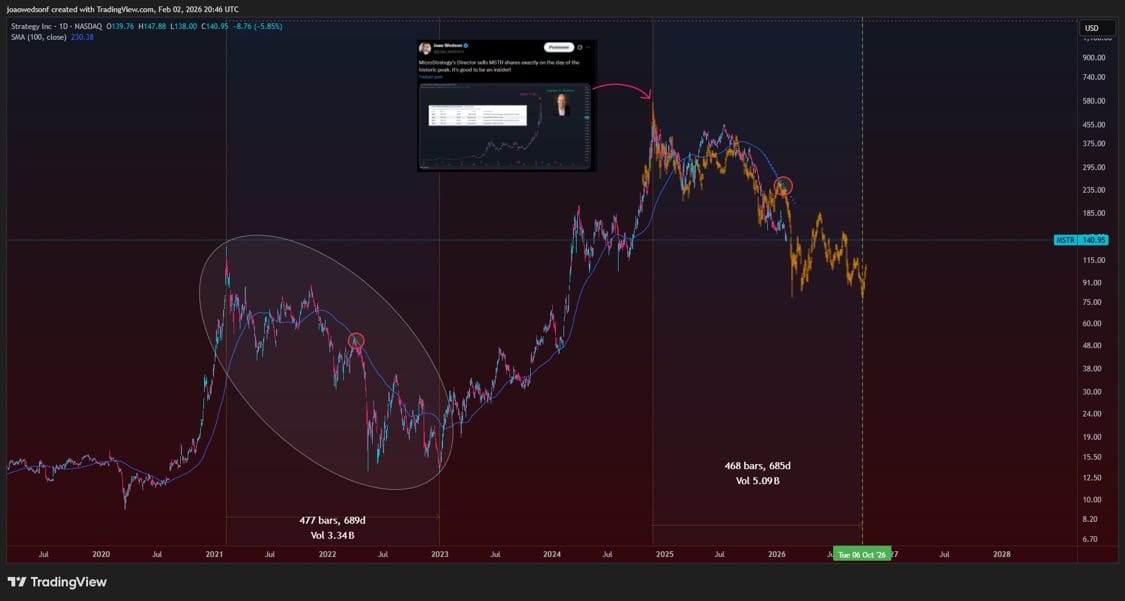
A bearish fractal forming on MSTR pointed to additional downside risk for both assets.
The structure mirrored MSTR’s 2021–2023 cycle, when the stock entered a prolonged decline marked by lower highs and lower lows. That phase lasted 689 days and saw about $3.34 billion in traded volume.

Source: Alphractal
The current pattern began in late 2024 and could extend roughly 685 days, with projected volume near $5.09 billion, according to Joao Wedson.
Selling pressure appeared to accelerate after Strategy’s directors sold shares near the November 2024 peak. Wedson estimated that MSTR could retrace toward $70–$80 from around $145 at the time of analysis.
“I estimate a fair price around $70–$80 per share, as each bear market cycle tends to produce smaller drawdowns,” Wedson said.
A move to $70 would represent roughly a 50% decline from current levels. Based on historical correlation, that scenario could pull Bitcoin [BTC] toward the $58,000 region, with deeper projections remaining less probable.
Bitcoin’s recovery remains uncertain
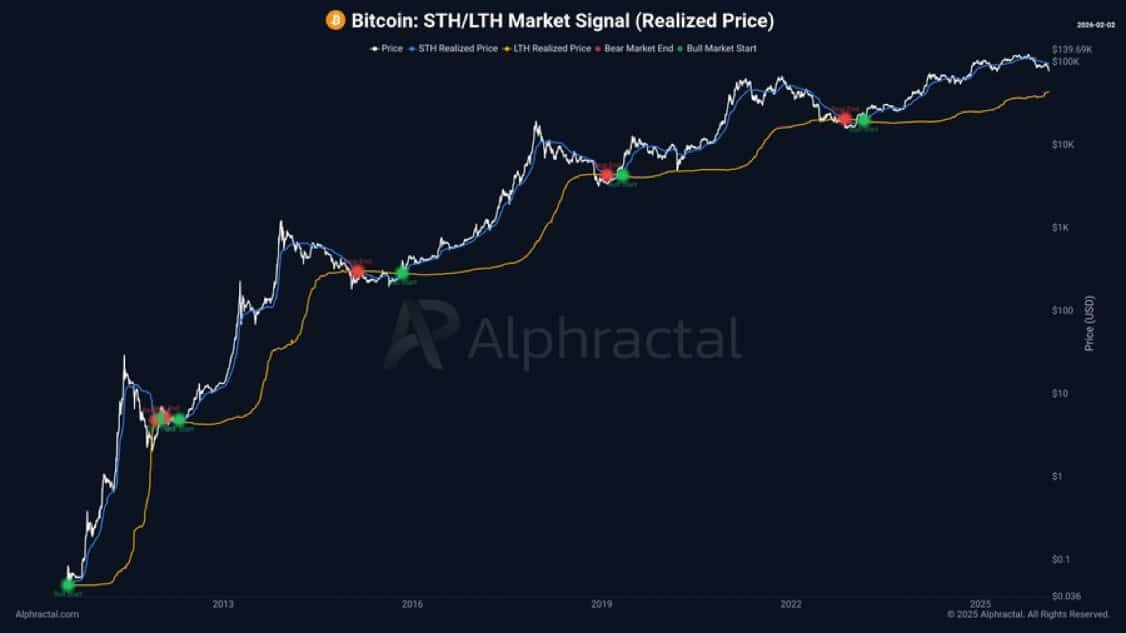
Bitcoin’s broader recovery remained uncertain when viewed through holder-based Realized Price signals.

Source: Alphractal
Historically, bull markets began when the Short-Term Holder Realized Price crossed above the Long-Term Holder Realized Price. Bear markets, by contrast, ended once Long-Term Holder Realized Price moved above short-term levels.
The charts showed a persistent gap between short- and long-term holder prices, marked by the absence of confirmed green reversal signals. Until that spread narrowed, downside risk remained elevated.
That structure kept traders focused on whether long-term holders would begin absorbing supply at lower levels.
Institutional investors step back in
Institutional behavior showed early signs of stabilization.
Despite Bitcoin revisiting April 2025 price levels, U.S. Spot Bitcoin ETFs recorded $561.9 million in net inflows on the 2nd of February, marking the first positive daily flow since mid-January, according to SoSoValue.
That shift suggested the two-week institutional selling streak may have paused.
Even so, sustained inflows would be required to offset the broader bearish structure.
Without confirmation from on-chain holder metrics, any rebound could remain corrective rather than trend-defining.
Final Thoughts
- Strategy [MSTR] mirrored its 2021–2023 fractal, pointing to downside risk. A projected move toward $70–$80 could pressure Bitcoin toward the $58,000 region.
- Short-Term Holder Realized Price remains below Long-Term Holder levels, though $561.9M in ETF inflows hints at early institutional support.
Source: https://ambcrypto.com/is-strategys-mstr-signaling-bitcoins-next-move-the-data-says/