Strategy’s 2025 Digital Credit tax treatment changes how investors must read MSTR’s earnings, dividends, and balance-sheet risk. What looks like income is legally return of capital (ROC), meaning cash distributions are not profits but a recycling of shareholder equity.

When combined with fair-value Bitcoin accounting, this structure makes MSTR behave less like a software company and more like a leveraged Bitcoin financial vehicle. The result is a new valuation logic where EPS, NAV premiums, and liquidity matter more than revenue growth.
MicroStrategy Q4 preview: what Zacks Investment Research and TradingView News consensus signal
Strategy’s Q4 preview matters because it reveals how accounting and Bitcoin price swings now dominate reported earnings. Investors must re-anchor expectations away from revenue growth toward asset revaluation risk.

According to the Strategy report, Strategy is expected to report Q4 2025 earnings on February 5, 2026. Zacks projects a consensus EPS of $46.02, reversing a -$3.20 loss last year, driven almost entirely by fair-value gains on Bitcoin, not by operating improvement.
Revenue, however, is projected at only $119.6M (-0.91% YoY), confirming that the traditional software segment is shrinking in relevance. TradingView analysis notes that MSTR’s share price now tracks Bitcoin volatility more than fundamentals, with retail sentiment turning bearish due to capital raises and BTC price risk.
Critically, Strategy now holds ~712,647 BTC as of January 2026, meaning its equity behaves like a synthetic leveraged Bitcoin ETF with balance-sheet risk.
Separate core software metrics from Bitcoin-driven impacts
To value MSTR correctly, investors must split operating software performance from Bitcoin market volatility. Without this separation, EPS and margins become meaningless signals.
The core software segment is projected to generate $118.47M in Q4 revenue (-1.85% YoY), while cloud subscriptions still grow, up 48% in 2024, as the firm shifts from on-prem to SaaS. Gross margin remains high at 68–72%, but scale is too small to justify MSTR’s market cap.
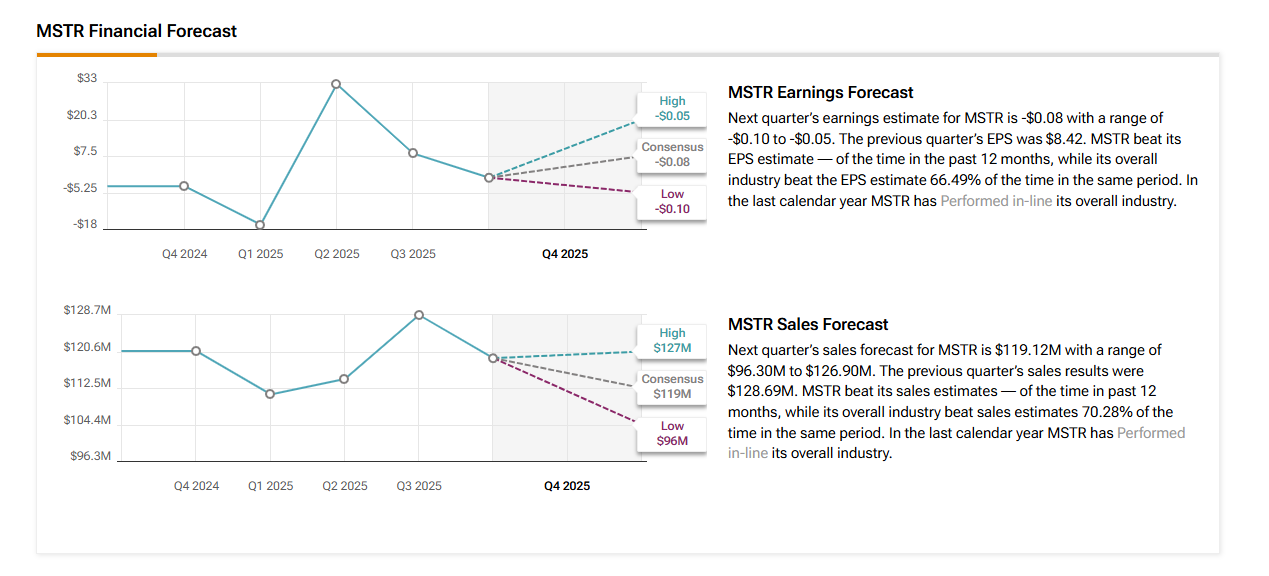
Meanwhile, Bitcoin introduces extreme P&L volatility. Under the new fair-value rule (Q1 2025 onward), all BTC price changes flow directly through income. In Q4 2025, a ~25% BTC drop caused an unrealized loss of $17.44B, flipping GAAP EPS to -18 to -19.
This contrast shows why analysts say the software unit is now “economically insignificant” to valuation. MSTR is priced almost entirely on the premium or discount to its Bitcoin NAV.
BTC sensitivity: EPS and equity pathways, key assumptions and risks
MSTR’s equity and earnings now act as a leveraged derivative on Bitcoin. Small BTC moves can create multi-billion-dollar swings in reported profit.
Under fair-value accounting, every BTC cycle transmits directly into EPS. A 25% BTC drop triggered a $17.44B loss in one quarter. Conversely, if BTC recovers, analysts project EPS could reach $46.02 in 2026, but only if BTC remains above ~$76,000.
Strategy’s “Bitcoin Yield” model relies on issuing debt and equity when its market-to-NAV (mNAV) ratio trades above 1. Historically, mNAV reached 2–3x, enabling accretive BTC purchases. Today, mNAV has fallen to 1.07–1.14, sharply reducing funding flexibility. If BTC drops below $50,000, the model risks a death spiral, where dilution and forced sales accelerate losses.
Valuation cross-check: implied BTC exposure vs core software value
Implied BTC exposure versus ETF fund flows and market liquidity
MSTR’s valuation must now be benchmarked against Bitcoin ETFs and liquidity flows, not software peers.
As of February 2026, MSTR’s market cap is ~$40.95B, while its BTC holdings (~713,502 BTC at $78,777) equal ~$56.2B. After subtracting $16.6B in debt and preferred stock, net equity equals ~$39.6B, meaning the stock trades near intrinsic BTC value with only a 3–6% premium.
ETF competition has changed the game. BlackRock’s IBIT alone holds ~614,639 BTC, offering low-cost exposure without leverage risk. When ETFs saw $6.18B in net outflows in late 2025, MSTR’s liquidity also tightened.
MSTR core software revenue, cost of capital, volatility-adjusted scenarios
The core software segment now represents <5% of MSTR’s valuation. Using an industry P/S of 4x, the software business is worth $1.9–$2.0B, versus a total market cap near $41B. Over 95% of equity value comes from BTC exposure.
Scenario analysis:
- Bull: BTC $150k → MSTR ~$90B
- Base: BTC $78k → ~$40B
- Bear: BTC $50k → ~$19B (forced asset sales)
What to watch: treasury strategy, balance sheet, cost of capital
Balance-sheet BTC strategy, yields, Japan risk-off signals, and fund flows
MSTR’s survival now depends on liquidity, not growth. Debt and preferred obligations exceed $16B, with $800–$900M/year in interest and dividends. Software cash flow (~$120M/quarter) cannot cover this alone.
Macro risk: tightening by the Bank of Japan strengthens the yen, triggering global risk-off flows that pressure BTC and MSTR simultaneously.
Quick Fact: BingX exchange is offering exclusive perks for new users and VIP traders.
Tax: Ellington Credit 2025, 1099-DIV, withholding, ordinary income vs capital gains
Digital Credit distributions are not ordinary income. They are ROC, reported in Box 3 of Form 1099-DIV, temporarily tax-free but reducing cost basis.
Strategy confirmed 100% of 2025 distributions are ROC, reducing basis, with excess taxed as capital gains. This mirrors rules for leveraged entities like Ellington Credit (EARN), where income classification determines after-tax yield
| DISCLAIMER: The information on this website is provided as general market commentary and does not constitute investment advice. We encourage you to do your own research before investing. |