Bitcoin’s monthly returns reveal a recurring cycle of sharp advances followed by corrective phases.
Periods of consecutive monthly losses, notably in 2014 and again in 2018, marked the unwind of overheated rallies rather than structural failure. Recent weakness follows the same pattern.
As Bitcoin [BTC] reached a new all-time high in October 2025, the results in the monthly returns contradicted the performance.
This was a result of tighter global liquidity, shifting ETF flows, and restrictive monetary conditions reducing marginal demand, thereby translating to negative returns in the same month.


Source: CoinGlass
At the same time, profit-taking has weighed on short-term performance.
Historically, Bitcoin delivered its strongest returns in 2013, 2017, and 2020–2021, while the weakest years followed speculative excess.
Recoveries typically emerged through consolidation, lower leverage, and renewed spot accumulation.
That recovery path remains viable under current conditions. This is because leverage is resetting.
Prolonged negative monthly returns typically coincide with forced deleveraging. Once that process matures, downside pressure weakens as marginal sellers exit.
Market deleveraging accelerates amid Bitcoin’s volatile decline
According to CoinGlass, liquidation data indicates a period of intense market stress.
As of press time, more than $5 billion in crypto positions were liquidated over the last four days.
This marked the largest liquidation event since the 10th of October 2025, with long liquidations exceeding $2.5 billion on peak days.


Source: CoinGlass
As liquidations increased, Bitcoin’s price declined alongside them, showing a strong relationship between forced selling and price weakness.
Similar patterns appeared in mid-November and early December, both followed by sharp price drops.


Source: CoinGlass
Bitcoin recently fell below $80,000 to about $77,700, triggering $1.6 billion in weekly liquidations.
A rebound toward $80,000 could liquidate $1 billion in short positions, potentially driving a short squeeze, although elevated leverage keeps market risks balanced.
Deleveraging resets market structure
Bitcoin’s price decline now moves alongside a clear drop in Open Interest.
As the price slipped toward $77,500, Open Interest dropped from about $47.5 billion to nearly $24.4 billion, indicating a reduction in leveraged positions.
This pattern indicates a cautious response from traders, who opt to reduce exposure instead of increasing aggressive bets.

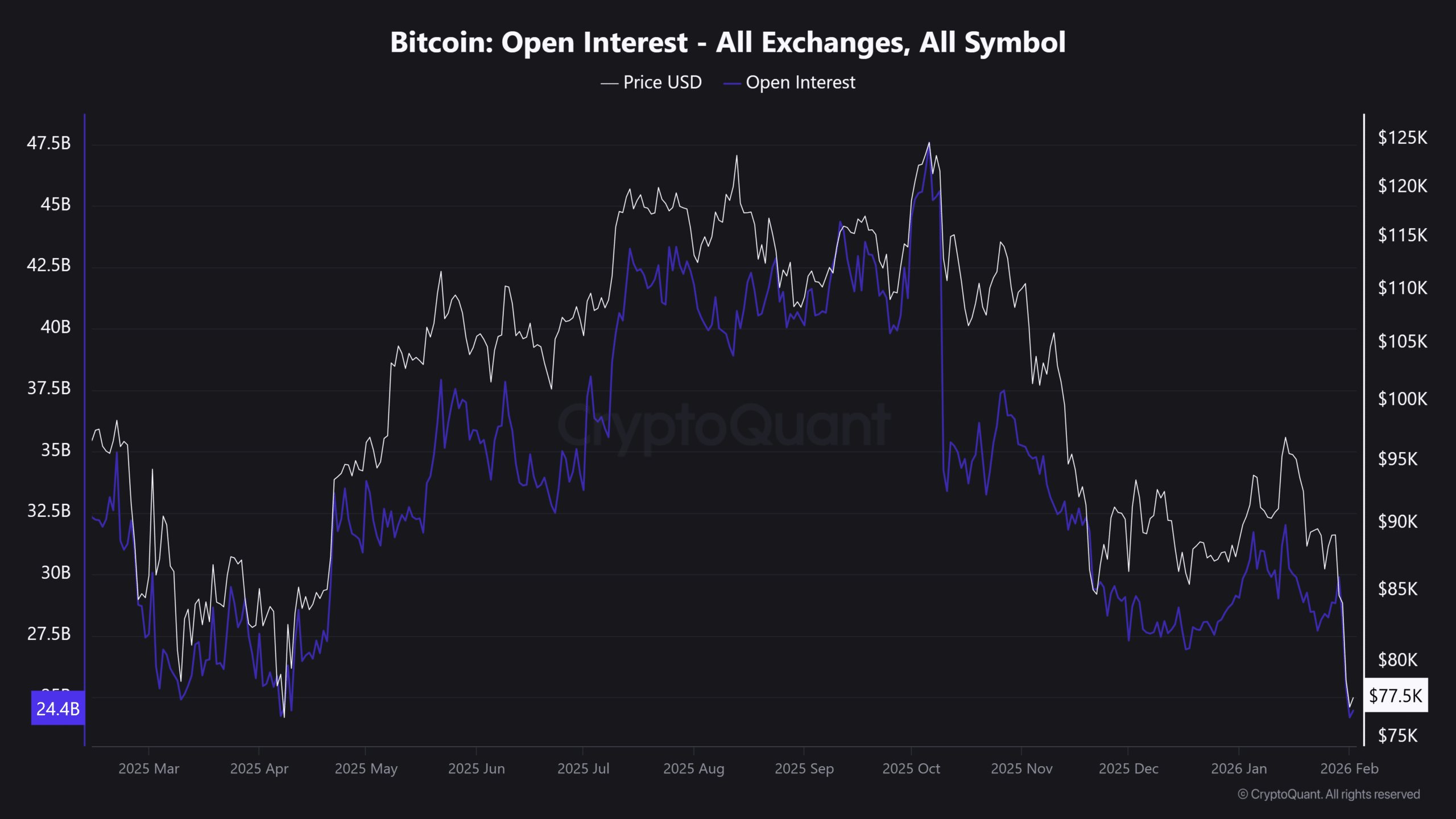
Source: CryptoQuant
In previous cycles, similar declines in both price and Open Interest appeared during late stages of deleveraging and often led to periods of consolidation.
Market structure remains weak as sentiment cools. Selling pressure persists, yet lower leverage points to growing fatigue.
All in all, the market now sits between further downside risk and the potential for stabilization once positioning resets.
Final Thoughts
- Bitcoin’s drawdown mirrors past post-rally corrections, where tightening liquidity and profit-taking triggered deleveraging rather than structural breakdown.
- Heavy liquidations and collapsing Open Interest show leverage is resetting, leaving the market balanced between further downside and stabilization.
Source: https://ambcrypto.com/bitcoin-leverage-unwinds-as-btc-slips-10-monthly-stabilization-ahead/