Bitcoin has now fallen to $78,441 in early 2026, wiping out nearly all the gains it built during the rally that began in spring last year.
After a slow first half of 2025, Bitcoin surged strongly in the second half of the year, reaching a record high of $124,700 in October 2025.
However, the momentum did not hold.
Over the past four months, Bitcoin has steadily declined, sliding back to the same price levels it last traded at in April 2025.
Factors responsible for this drop
Topping the list is the nomination of Kevin Warsh as the next Federal Reserve Chair, which changed how markets see interest rates.
His hawkish stance has raised fears that rate cuts will slow or stop, strengthening the U.S. dollar and reducing appetite for risk assets like Bitcoin.
At the same time, rising geopolitical and trade tensions have pushed investors into defensive mode.
Another key factor is capital rotation.
Unlike past cycles, Bitcoin failed to rise alongside gold and silver.
Additionally, as prices began to fall, large liquidation events and complex leverage structures quickly unraveled.
What started as a gradual decline turned into a sharp selloff, driven more by forced liquidations than investor panic.
At the same time, the excitement around spot Bitcoin ETFs has faded, with large outflows as professional investors reduced risk.
Then, the expectations around broader government adoption, such as a U.S. strategic Bitcoin reserve, have not yet turned into action, leading to disappointment-driven selling.
Circulating fears
Naturally, this sharp price drop has revived some of crypto’s oldest fears, especially around Satoshi Nakamoto.
Although Bitcoin’s creator has been silent for over 15 years, the belief that Satoshi still controls around 1.1 million BTC continues to weigh on market sentiment.
Some investors fear that even a small movement of those coins could shake confidence and trigger a major selloff.
However, not everyone agrees.
Kevin O’Leary dismisses these fears, arguing that the current volatility is simply a clearing phase before a much larger institutional wave enters the market.
In his recent interview, he added,
“Until Bitcoin becomes a regulated security through the Clarity Act and gets up to 150,000 or maybe 200,000 where you’re agnostic to either leasing the power at sub six cents a kilowatt hour to it hyperscaler or mining Bitcoin.”
Technical parameters
On the technical side, things still look heavy.

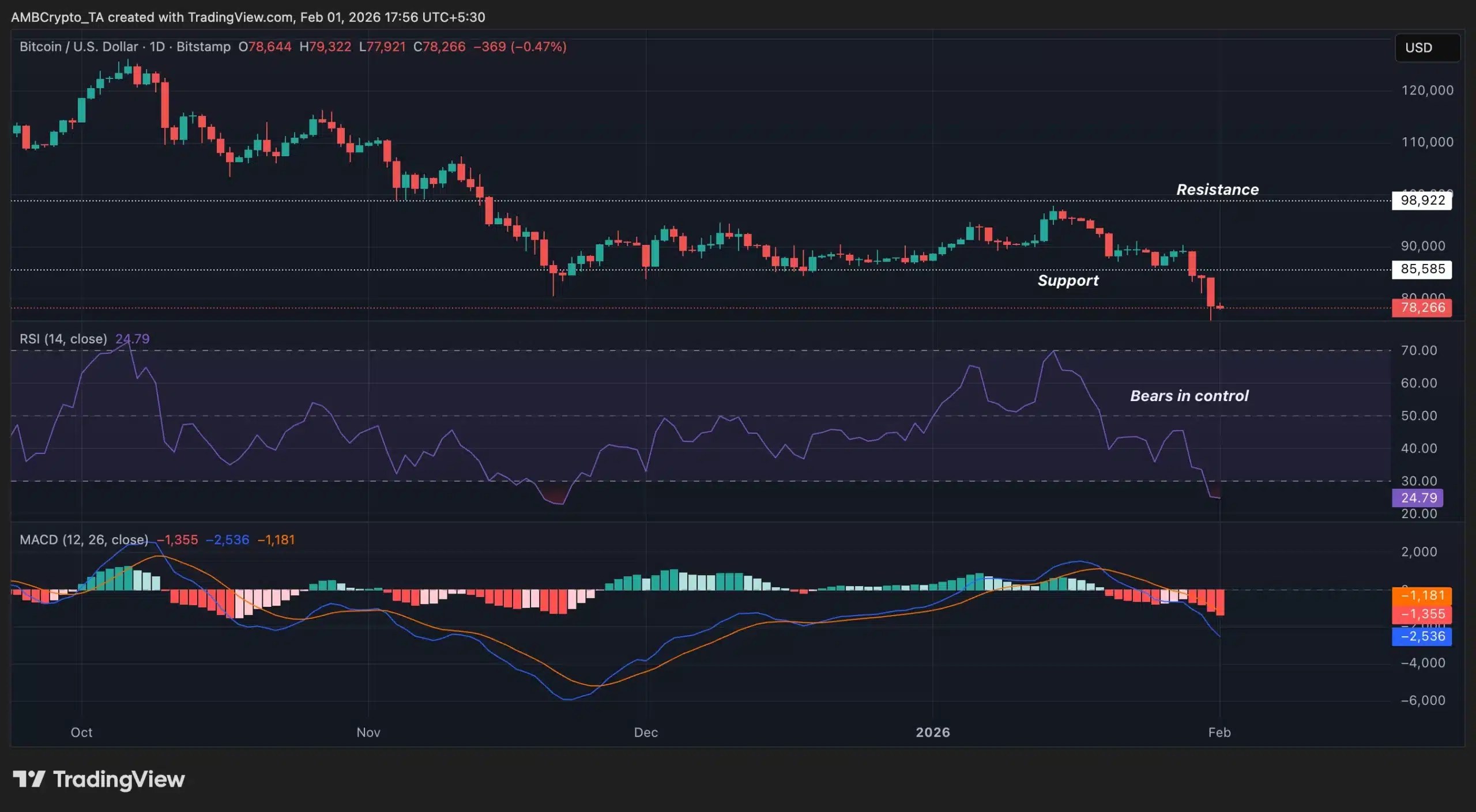
Source: Trading View
Indicators like the MACD remain bearish, showing the impact of Bitcoin’s four-month decline from its October peak.
That said, there is one positive sign, as the Relative Strength Index (RSI) has dropped into oversold territory.
In the past, this level often meant that selling pressure was close to running out.
When that happens, prices can bounce sharply in the short term.
This suggests the current level around $78,441 may be stronger support than it appears.
Beyond charts
Looking beyond charts, market sentiment is holding up better than expected.
Bitcoin’s dominance also stands at 59.82%, showing that capital is staying in Bitcoin instead of flowing into smaller altcoins.
Therefore, in the end, Bitcoin is in a high-pressure waiting phase.
The next few weeks will be key in deciding whether fear takes over or a recovery begins. For now, the market feels stretched, and a bounce may arrive sooner than many expect.
Final Thoughts
- This correction has been less about price and more about credibility in a tightening global environment.
- Oversold technicals suggest selling pressure may be close to exhaustion, even if confidence hasn’t fully returned.
Source: https://ambcrypto.com/bitcoin-from-124700-to-78000-btcs-rise-fall-and-reality-check/