Michael Saylor’s Strategy Bitcoin purchase is operating directly at its cost basis but is not facing forced liquidation. On February 1, 2026, Michael Saylor posted “More Orange” after BTC dropped over 13%, confirming Strategy’s fifth Bitcoin purchase of the year.

The firm holds 712,647 BTC at an average cost of $76,037, while BTC trades near $78,000 after briefly dipping to $75,200–$75,500. Strategy’s leverage remains structurally stable because its debt is unsecured and long-dated.
Most obligations cannot be enforced until 2027–2028, eliminating margin-call risk even if BTC stays below cost. With $2.25 billion in cash reserves, the company can cover dividends and interest for at least 2.5 years under current conditions.
Is Michael Saylor’s ‘More Orange’ a confirmation? How to verify
Yes, Michael Saylor’s “More Orange” has become an unofficial but highly reliable confirmation that Strategy is about to disclose a new Bitcoin acquisition. On Saylor’s Bitcoin inventory chart, each orange dot represents a discrete BTC purchase event.
He typically posts cryptic phrases like this on weekends, followed by Form 8-K filings on Monday confirming the transaction. The symbolism is deliberate: orange represents Bitcoin, and the message signals that Strategy is accumulating rather than trading. This pattern has repeated across multiple buying cycles.
How to verify
- SEC EDGAR – Form 8-K: the only definitive record of BTC amount, total spend, and average price.
- Investor Relations: official press releases.
- SaylorTracker and BitcoinTreasuries.net tracking Michael Saylor’s BTC holdings.
BTC market context: price downturn and leverage flush framing
The latest “More Orange” appeared during a sharp Bitcoin correction and a market-wide leverage flush. By Feb 2, 2026, BTC had fallen from October 2025 highs to $76k–$78k.
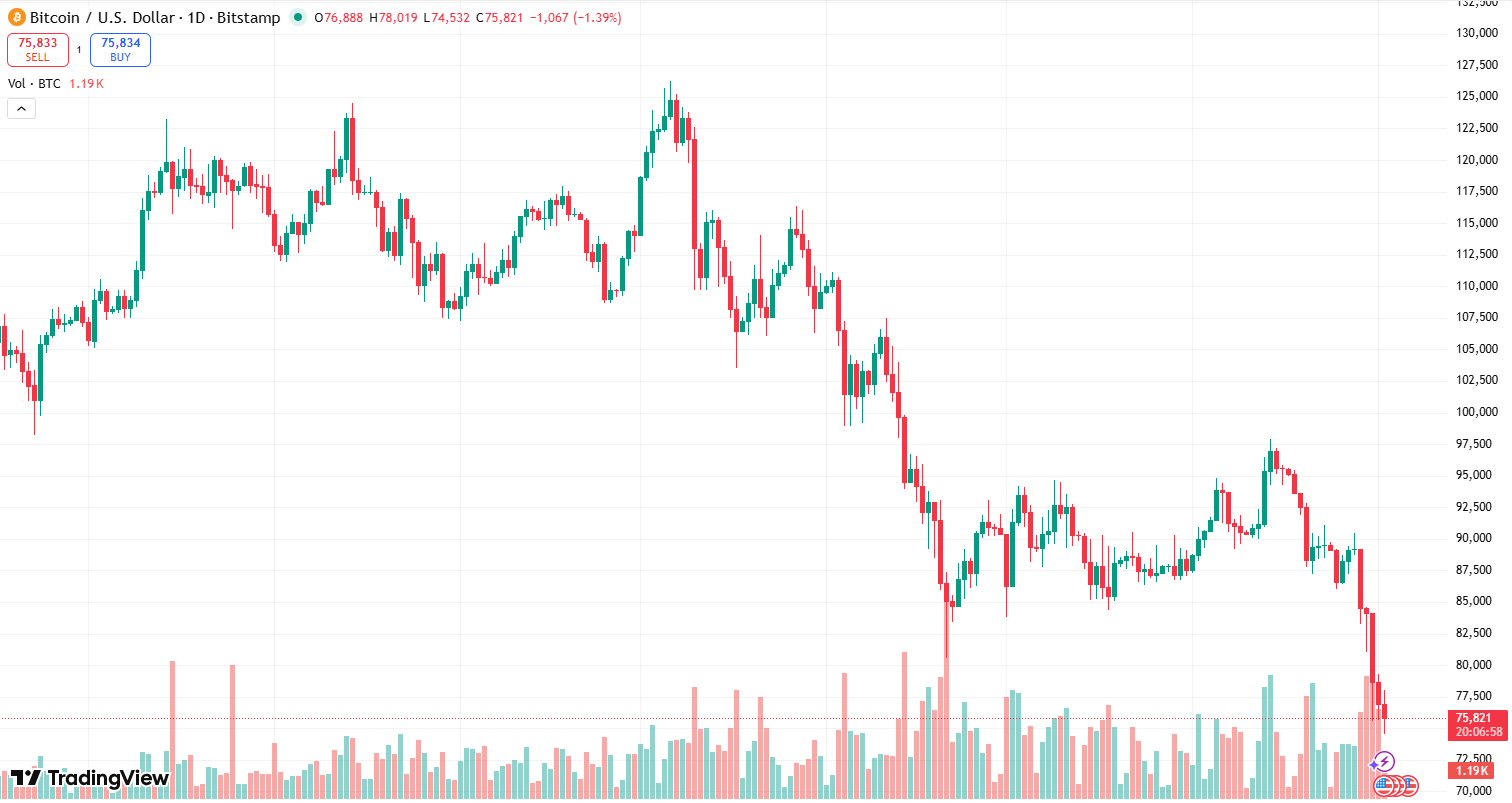
Leverage cleansing (Jan 7–Feb 2, 2026):
- $5B+ liquidations in four days.
- $2.2B liquidated on Feb 1 when BTC briefly broke $76,000.
- Funding rates turned negative (-0.0051%), showing long capitulation
Macro pressure
- U.S. government shutdown fears.
- Escalating Middle East tensions.
- Bitcoin ETF outflows.
- Synchronized declines in gold and silver, breaking BTC’s safe-haven narrative.
Analysts now expect BTC to bottom in the $70k–$75k range, with a worst case near $56k, a key stress scenario for Michael Saylor’s Strategy Bitcoin purchase thesis.
MicroStrategy’s BTC reserves, average purchase price, and cost basis
Strategy is the world’s largest enterprise Bitcoin holder with a structurally leveraged balance sheet.
As of February 2026, the company controls 712,647 BTC, representing roughly 3.4% of total circulating supply. This concentration makes Michael Saylor’s equity performance tightly coupled to Bitcoin’s macro price cycles.
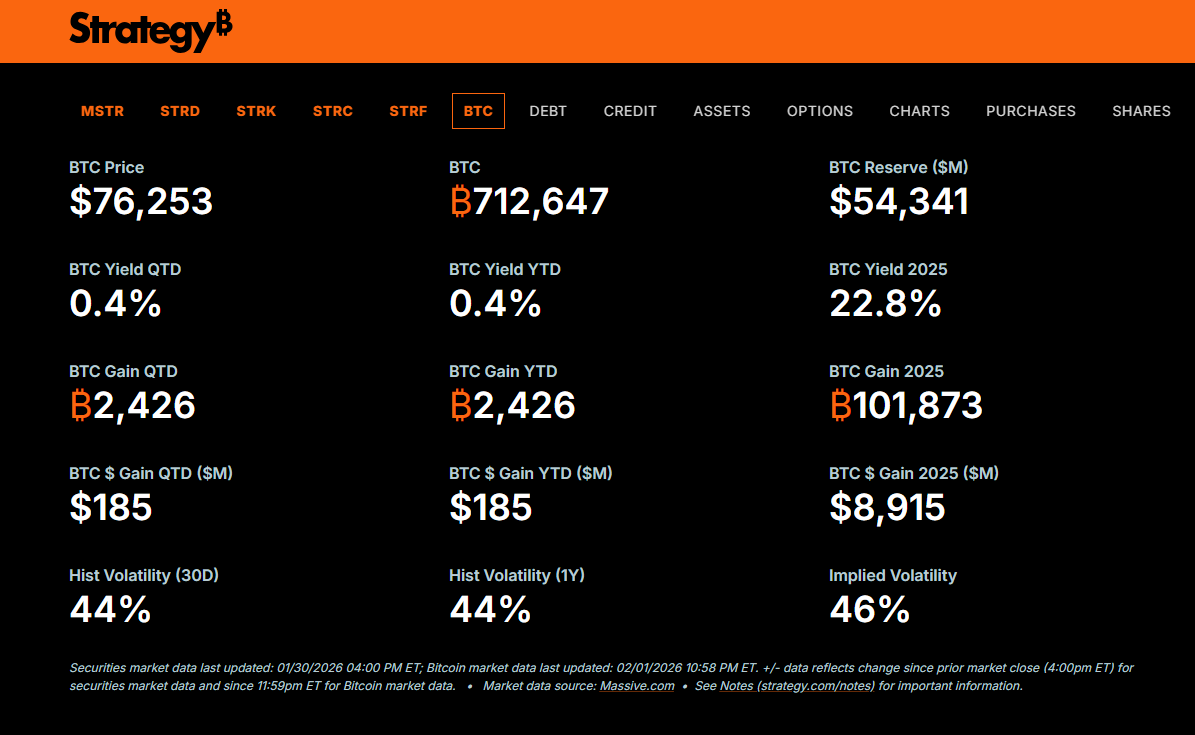
The firm’s average purchase price is $76,037 per BTC, creating a narrow margin of safety.
With Bitcoin trading between $76,000 and $78,000, Strategy’s portfolio is hovering around its full-cost breakeven zone. Even small price declines now translate into large swings in unrealized gains or losses.
The total cost basis is approximately $54.19 billion, making this one of the largest single-asset treasury exposures in financial markets. This structure amplifies both upside and downside, turning Bitcoin volatility into a balance-sheet stress test that directly impacts shareholder dilution risk and financing flexibility.
Financing options: preferred, common, or convertible notes trade-offs
Preferred stock dividends and treasury strategy implications
STRC has become Michael Saylor’s primary capital engine, but it also introduces fixed cash-flow obligations. The company raised the dividend on its Series A Perpetual Stretch Preferred Stock (STRC) by 25 basis points to 11.25%, marking the sixth increase since July 2025.
STRC is a perpetual preferred security that pays monthly cash distributions and adjusts its rate to trade near the $100 par value. Since launch, STRC has funded over 27,000 BTC, making it Michael Saylor’s dominant fundraising instrument.
Implications
- Cash-flow burden: dividends must be paid even during BTC drawdowns.
- BTC Yield KPI: success is measured by growth in BTC per share exceeding the cost of capital.
- Premium leverage: works best when MSTR trades above BTC NAV.
- Bear risk: in a leverage flush, 11.25% becomes harder to service
Common equity vs convertible notes: dilution and cost trade-offs
Strategy continuously balances the trade-off between immediate dilution and future debt risk.
To finance Bitcoin purchases, management must choose between issuing common shares through at-the-market programs or raising capital via ultra-low-interest convertible bonds, each shifting risk to different parts of the balance sheet.
| Tool | Dilution | Cash Pressure | BTC Down | BTC Up |
|---|---|---|---|---|
| ATM Equity | Instant | None | Safer | Increases BTC Yield |
| Convertibles | Delayed | High if not converted | Riskier | Extreme leverage |
Common equity (ATM)
- Creates instant dilution but carries no debt or interest burden.
- Most effective when MSTR trades at a premium to NAV, allowing the company to sell higher-valued shares and acquire Bitcoin at market prices.
Convertible notes
- Carry 0–1% interest and cause delayed dilution.
- If the stock fails to reach the conversion price, the principal must be repaid in cash, which becomes dangerous during prolonged drawdowns.
Board authorization and capital markets execution considerations
The board pre-approves massive issuance limits, then management executes opportunistically. For example, the “21/21” plan authorizes $21B equity + $21B bonds over three years. Once approved, Michael Saylor’s team can “press the button” without reconvening, allowing rapid responses to BTC price swings.
Which tool when
- High equity premium → ATM
- Strong bond demand → Convertibles
- Market panic → Preferred stock (STRC)
What MSTR investors and BTC holders should watch next
SEC filings, press releases, and MicroStrategy Board approvals for transactions
Form 8-K filings are the only definitive confirmation of Strategy’s Bitcoin purchases. Each time the company completes a material acquisition using newly raised capital, it must submit this report within four business days, detailing the number of BTC purchased, the total cost, and the average price.
Beyond filings, investors should track board authorizations for new issuance programs. Expanded limits for equity, preferred stock, or convertible bonds signal that additional Bitcoin purchases are likely, even if no public hints are given by management.
Balance sheet and cost basis updates during BTC drawdowns
The $76,037 cost basis is the most important financial stress marker on Strategy’s balance sheet. When Bitcoin trades near or below this level, the company’s entire treasury position shifts from unrealized profit to book losses, increasing pressure on liquidity and investor confidence.
During drawdowns, investors should monitor whether Strategy continues buying through dilution. Persistent accumulation below cost basis indicates confidence in the BTC Yield model, but it also increases long-term dilution risk if the recovery cycle is delayed.
MSTR stock performance and dilution risk indicators
The premium or discount of MSTR shares relative to Bitcoin net asset value defines the sustainability of the strategy. When the stock trades above NAV, Strategy can issue equity efficiently to increase BTC per share. When that premium disappears, dilution becomes value-destructive.
Investors should also watch the stock’s beta to Bitcoin. If MSTR falls faster than BTC during market corrections, it signals rising leverage stress and reduces the company’s ability to recycle capital into new Bitcoin purchases.
| DISCLAIMER: The information on this website is provided as general market commentary and does not constitute investment advice. We encourage you to do your own research before investing. |