Market tension escalated on the 29th of January, following a large-scale liquidation event that wiped billions of dollars across asset classes. The sell-off hit both gold and cryptocurrencies, triggering visible capital movement into Bitcoin and other risk markets.
Bitcoin [BTC], the world’s largest cryptocurrency by market value, fell to around $81,000, a level last seen in April 2025, dragging its market capitalization down to roughly $1.64 trillion.
Gold, however, suffered a more severe blow. Nearly $1.60 trillion was erased from its market value over the same period, a loss approaching the size of Bitcoin’s entire market capitalization.
Still, analysts argue the broader setup may ultimately favor Bitcoin, with growing expectations that capital rotation could define the market’s next phase.
Early signals point to a gold-to-Bitcoin rotation
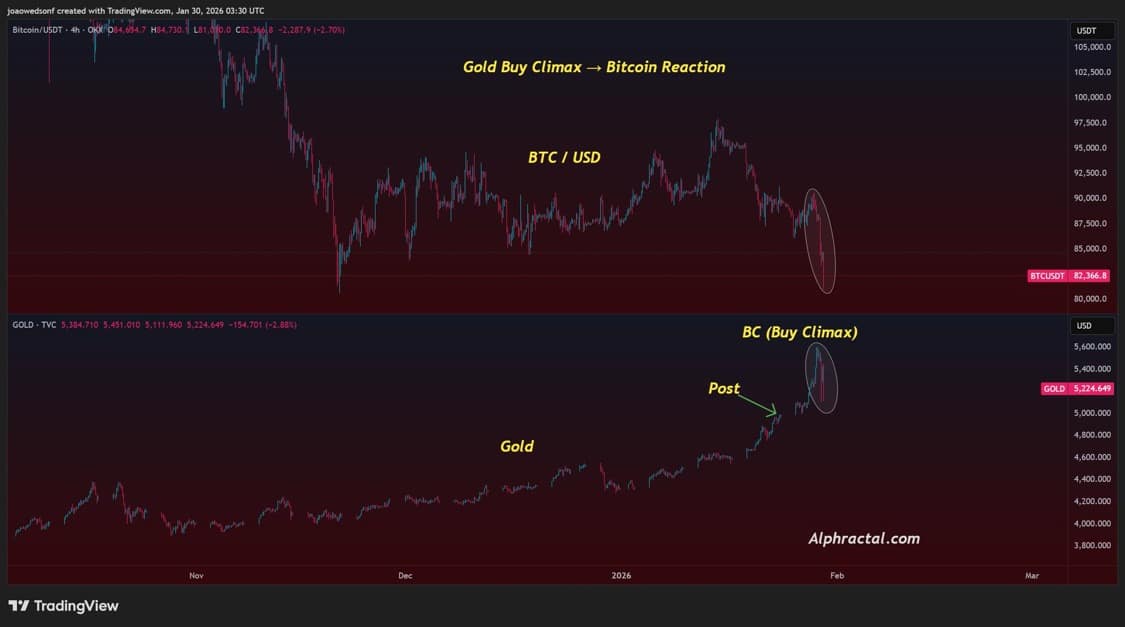
João Pedro, a market analyst and founder of Alphractal, had flagged the possibility of a rotation weeks earlier.
In a prior post, he noted that gold was approaching a ‘Buy Climax,’ a phase often followed by a liquidation event and temporary weakness in Bitcoin. That sequence has since unfolded almost precisely as anticipated.
According to João, gold’s recent surge reflected an influx of late buyers, which helped drive momentum higher. Historically, this phase tends to revive “optimism and complacency” before transitioning into sideways price action, territory gold may now be entering.
“As liquidity gradually exits gold, the probability increases that capital rotates into risk assets.”
For many investors, major cryptocurrencies remain the primary risk assets of choice, with Bitcoin firmly at the center of liquidity and market attention.

Source: TradingView
João’s view is echoed by Henrik Zeberg, head macroeconomist at Swissblock, who believes the BTC–gold ratio may be forming a long-term bottom.
“Large bottom in for BTC-GOLD ratio imo. Let the rotation begin.”
While there is no definitive timeline for how long this transition may take, the broader implication points toward renewed capital inflows into Bitcoin.
João reinforced this outlook, stating:
“Historically, this phase unfolds over several months and appears closely aligned with the historical fractal Bitcoin has followed across cycles—the window where large institutional capital reallocates aggressively into Bitcoin.”
Bullish conditions begin to align for Bitcoin
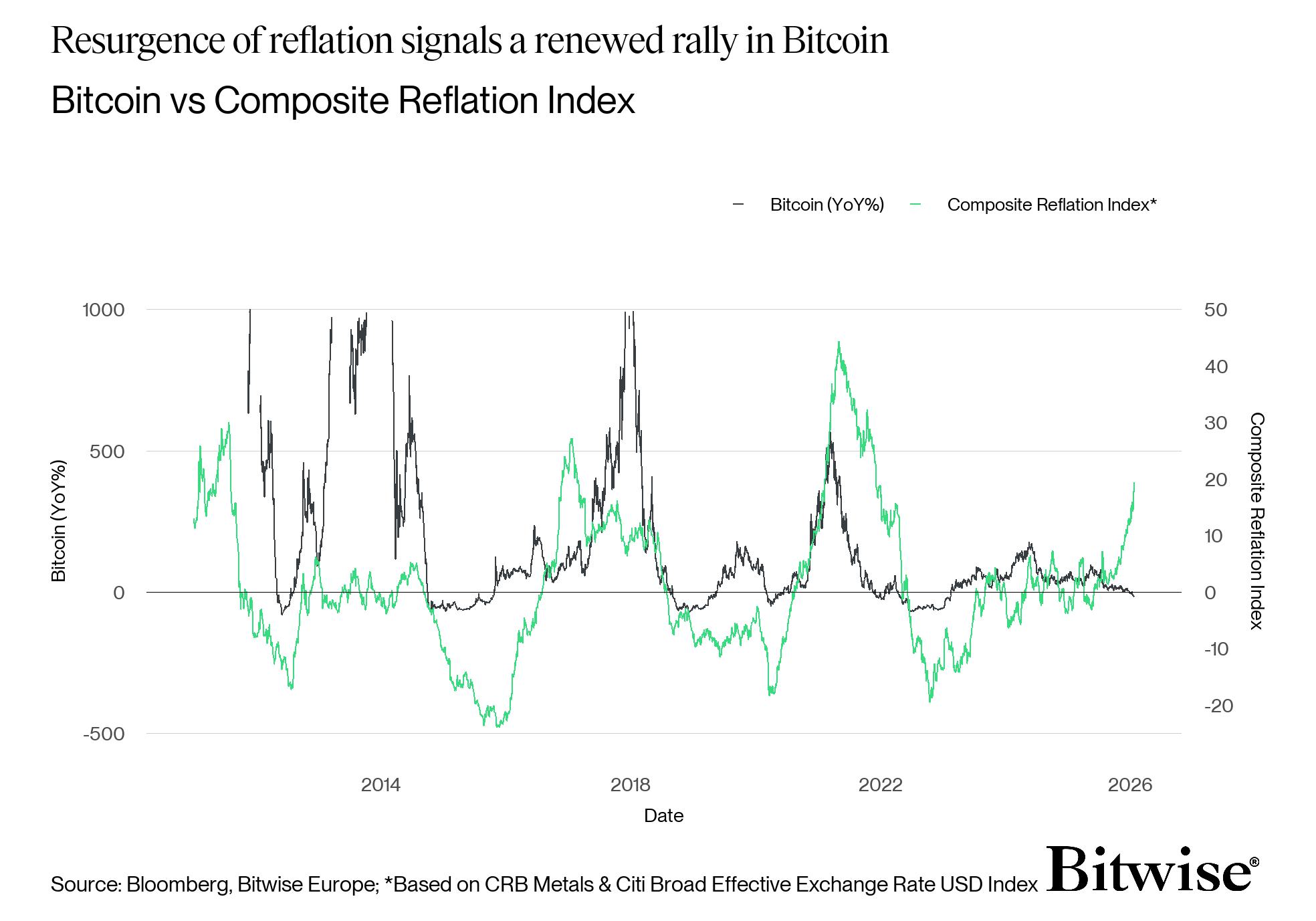
Bull-market sentiment is gradually building, according to André Dragosch, European head of research at Bitwise, who believes the ongoing strength in precious metals could ultimately support a renewed Bitcoin rally.
Dragosch links this outlook to reflation, a phase marked by policies aimed at stimulating economic activity. He argues that the absence of such macro tailwinds has delayed risk appetite, but not eliminated Bitcoin’s long-term appeal.
Despite the challenging macro backdrop, he points out that Bitcoin exchange-traded products (ETPs) and corporate treasury holdings have increased exposure by roughly 4.2 times, underscoring growing institutional conviction.

Source: Bitwise
He adds that several catalysts could drive the next leg higher, including trends in the ISM Manufacturing Index, the appointment of a new Federal Reserve chair, increased capital deployment by major U.S. wirehouses into Bitcoin ETFs, and more companies adopting Bitcoin treasury strategies.
Commenting on relative valuation, Dragosch noted:
“BTC-Gold is heavily under-priced and over-sold any way you look at it,” adding that “this relative performance between BTC/Gold tends to move with global risk appetite.”
He emphasized that Bitcoin historically performs best in risk-on environments and struggles when investors retreat into defensive positioning.
Dragosch also highlighted a recurring market pattern: gold typically moves first, leading Bitcoin by four to seven months, after which Bitcoin tends to outperform on a percentage basis.
Short-term weakness tests key technical levels
Bitcoin has slipped below its two-year simple moving average (SMA), a level that previously acted as a critical support zone.
Holding below this threshold could expose the asset to further downside pressure if bearish momentum persists.
However, history suggests this phase has often laid the foundation for major rallies. In previous cycles, dips below the two-year SMA coincided with prolonged accumulation by long-term investors ahead of broader bull markets.


Source: Alphractal
This aligns with the prevailing narrative of a gradual capital rotation from gold into Bitcoin, one that could see large institutions and their clients quietly build positions before a renewed rally emerges, once again without a precise timeline.
Final Thoughts
- Bitcoin stands to benefit if capital continues to rotate out of gold and into risk assets, though there is still no clear timeline for when this shift could meaningfully accelerate.
- A combination of economic relief and a broader risk-on environment may ultimately provide the catalyst needed for a sustained upside move.
Source: https://ambcrypto.com/analyst-warns-of-golds-buy-climax-as-capital-shifts-toward-bitcoin/