SpaceX, Elon Musk’s private company specializing in sending rockets into space and beaming an internet connection out of it, is mulling an initial public offering (IPO) as soon as June 2026.
The company – best known to most consumers for operating the Starlink network of internet satellites – would enter the stock market at an eye-watering valuation of $1.5 trillion while seeking to raise approximately $50 billion.
Not only would such a market capitalization mean that SpaceX has almost doubled its value in about six months – in December, the firm’s valuation stood at $800 billion – but would make the company the world’s 10th-largest.

For comparison, Tesla (NASDAQ: TSLA) – the electric vehicle (EV) maker and Elon Musk’s only publicly-traded firm at press time on January 29 – is valued at $1.43 trillion, making it smaller than SpaceX’s proposed value.
Why Musk is considering a SpaceX June IPO
While the South African-Canadian-American billionaire has previously reportedly voiced his preference for keeping the space firm private, recent trends have allegedly compelled him to reconsider.
Governments, customers, and investors have become more interested in various space-based operations, and there is a growing demand for companies operating outside the Earth’s atmosphere.
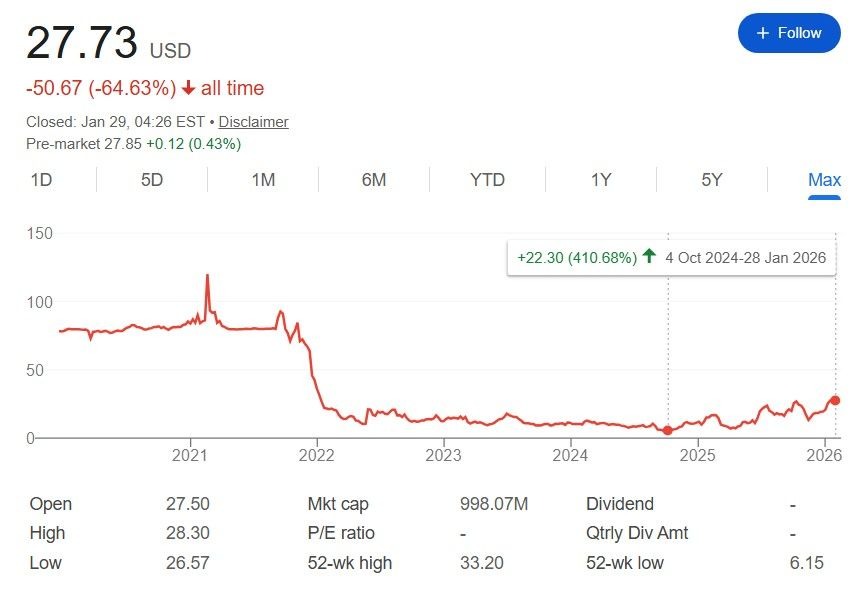
BlackSky (NYSE: BKSY), a company specializing in geospatial intelligence and a firm Finbold identified as a promising investment late in 2024, is a strong showcase for the potential of such corporations.
Indeed, BKSY shares have rallied more than 100% in the last 12 months, and more than 400% since October 2024. On the other hand, BlackSky also demonstrates that, for all of its long-term promise, SpaceX’s immediate valuation might not be sustainable.
The risks for SpaceX’s possible IPO investors are evident in multiple recent trends. For one, Earth’s orbit is getting somewhat crowded amidst rising competition in satellite-launching between nations and corporations
For example, Montenegro – a small Balkan nation with a population of 623,327 and a nominal GDP of just $9.350 billion – managed to launch its first-ever satellite in December 2025.
In January 2026, a near miss by a Chinese satellite prompted SpaceX to move more than 4,000 of its own satellites into a lower orbit.
Elsewhere, Starlink itself has been courting controversy that could present a strong headwind for SpaceX after the company goes public, potentially even outweighing the tailwinds generated by the firm’s recent successes.
On the one hand, reports from 2024 indicated that Elon Musk’s space company might be endangering humanity’s entire orbital infrastructure via heightened levels of radiation leaking.
On the other hand, and more recently, Ukraine has claimed that most Russian drones, as of 2026, are equipped with Starlink terminals, thus having a de facto unlimited range.
Featured image via Shutterstock
Source: https://finbold.com/is-spacexs-1-5-trillion-ipo-coming-in-2026/