For years, Ethereum [ETH] has been caught between two opposing goals – Staying fully decentralized while still being easy enough for mainstream users. Balancing these two has never been simple.
However, in early 2026, that balance is starting to shift again.
With market sentiment struggling, Ethereum co-founder Vitalik Buterin has made it clear that this moment is about more than price action. Remarking on the same, an X account – Ethereum Daily noted,
“Ethereum Enter God Mode in 2026.”
Running Ethereum from your own laptop
So, for the longest time, running an Ethereum node became too demanding for regular users. Most people had to rely on large companies and data centers instead.
In 2026, however, new tools like ZK-EVMs and Block Access Lists (BAL) are changing this. Zero-knowledge proofs shrink complex block checks into small proofs that are easy to verify. On the other hand, BAL improves how nodes read blockchain data, reducing hardware needs.
This has resulted in regular users being able to once again verify Ethereum on a normal laptop, putting control back in individual hands.
Verifying data instead of trusting it
Secondly, most users used to access Ethereum through third-party services called RPC providers. These services would tell your wallet things like balances and transaction data.
Helios, a new light client, fixes this.
It lets wallets verify that the data from RPC providers is correct. Instead of trusting a service, users can now confirm the information themselves.
Stronger privacy for everyday use
In the past, Ethereum has struggled with privacy a lot. Each time you check a balance or make a trade, you leave data trails that can be tracked.
In 2026 though, two tools are helping solve this.
ORAM hides which data you are requesting by mixing it with other requests. Additionally, PIR lets you retrieve information from a database without revealing what you asked for.
Combined with account abstraction, these tools make private transactions easy and natural without extra steps.
Safer wallets without seed phrase stress
Not only these, but seed phrases have also long been a problem. If you lose them, your funds are gone forever. Right now though, Ethereum is moving towards social recovery wallets.
Instead of one secret phrase, your wallet can be recovered using trusted people or devices. If something looks wrong, timelocks add a delay, giving you time to stop unauthorized actions.
This makes wallets safer and more forgiving for everyday users.
Apps that can’t disappear
Finally, many decentralized apps still rely on centralized servers. If those servers fail, the app becomes unusable.
In 2026, Ethereum apps have been shifting to on-chain and decentralized interfaces using IPFS. This means the app stays available even if the original developers leave. This also meets Vitalik Buterin’s “walkaway” idea.
Echoing similar sentiments, an X user noted,

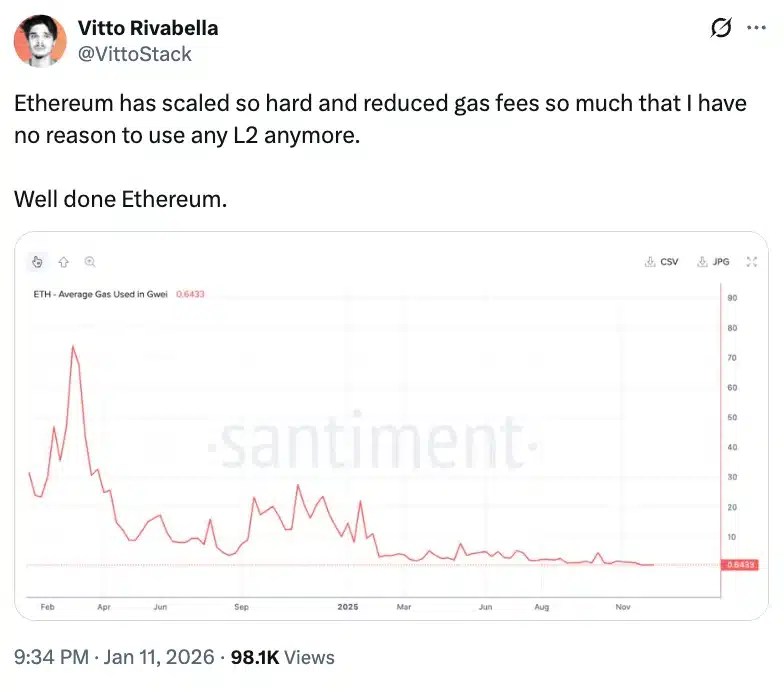
Source: Vitto Rivabella/X
Aother user added,

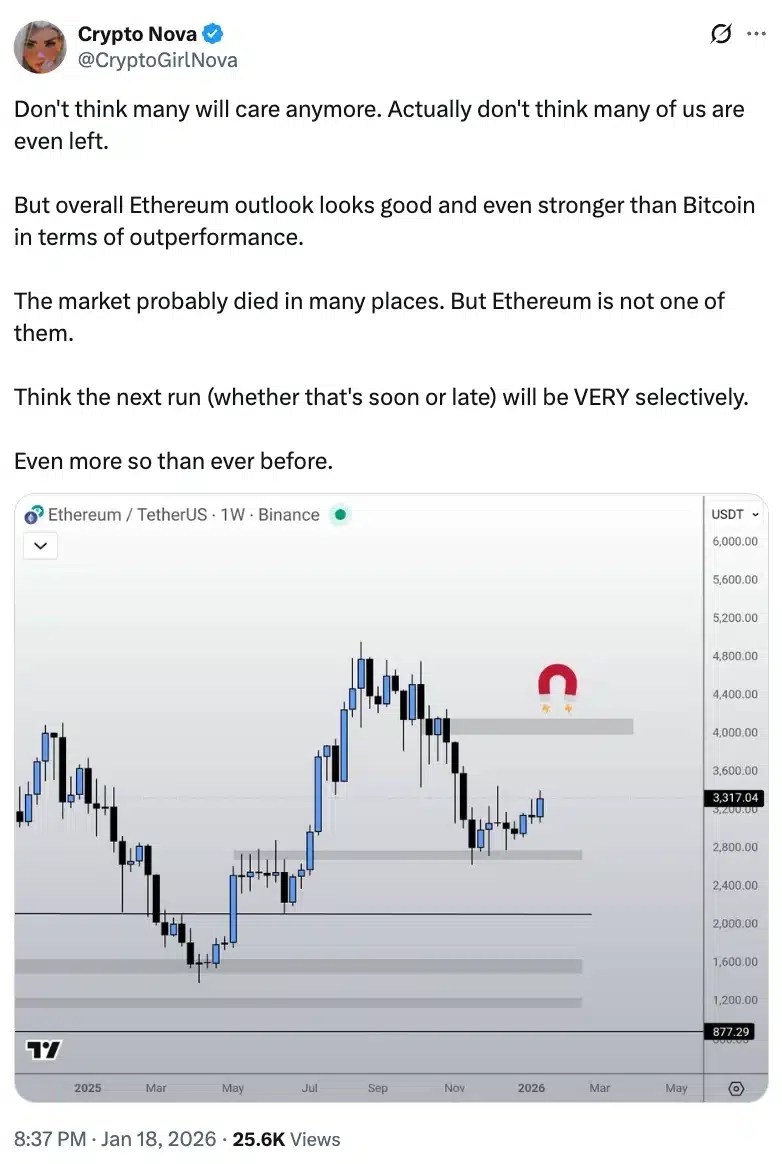
Source: Crypto Nova/X
What’s more?
This renewed focus on Ethereum’s technical sovereignty comes at a volatile moment for the market. At the time of writing, ETH was trading at $2,942.22, following a 5.4% dip in the last 24 hours.
And yet, the price action seemed secondary to the ideological pivot currently underway.
Especially since Vitalik Buterin is making it clear that 2026 is the year Ethereum doubles down on its original DeFi and blockchain ethos. In a candid assessment, he noted that the last decade was marked by a “serious backsliding” of core principles – A direct side effect of chasing mainstream adoption.
Final Thoughts
- Ethereum is choosing principle over popularity in 2026, even if that choice slows down short-term growth.
- Market prices may fluctuate, but architecture lasts, and Ethereum is clearly investing in long-term resilience.