After apparently promising a climb back to $100,000 for about a week, Bitcoin (BTC) suddenly reversed late on Sunday, January 18, and ended up trading at $93,013 by press time on Monday.
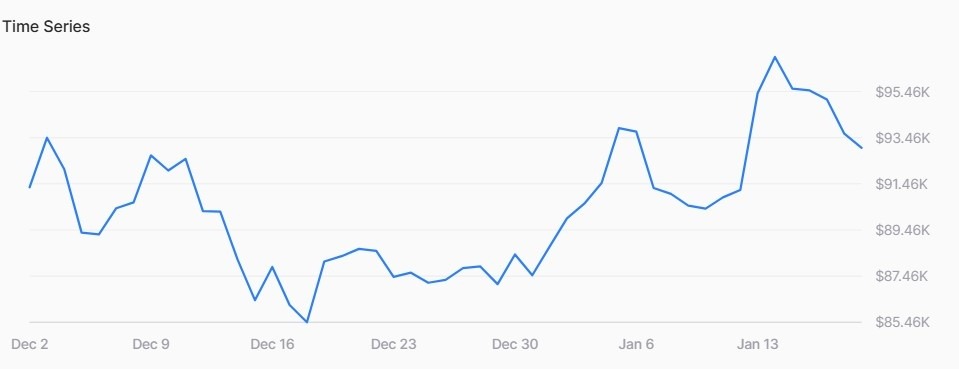
The reversal – also evident across the entire cryptocurrency market, as it erased some $100 billion from its market capitalization in approximately 12 hours – appears driven by a combination of relatively thin liquidity and risk-off behavior from investors amidst the reemergence of the trade war between the U.S. and E.U.
While the political and economic climates both hint at more price curveballs coming, advanced machine learning algorithms Finbold consulted on Monday, January 19, appear to estimate that Bitcoin’s price levels shall remain stable by the end of the month.
Bitcoin AI price prediction
After analyzing six BTC technical indicators, Finbold’s artificial intelligence (AI) prediction platform estimated, on average, that the world’s premier cryptocurrency will rally a mere 1.6% by January 31, and rise from its press time price of $93,013 to $94,500.
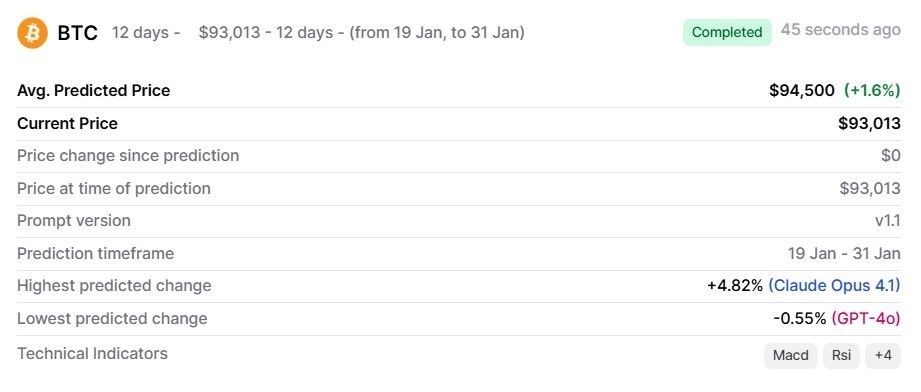
Claude Opus 4.1 proved the most bullish of the models included in the forecast system as it sets its Bitcoin price target at $97,501, indicating a 4.82% rise is coming. On the flip side, ChatGPT-4o was the most bearish as it predicted a 0.55% drop to $92,500 by January 31, 2026.
Bitcoin price technical indicators
Bitcoin’s overall price performance since 2026 started, and the prevailing technical indicators can explain the conservative machine learning predictions. Specifically, BTC has been trading with significant volatility, and the cryptocurrency already saw two substantial rallies and two major corrections in less than three weeks.
Technicals are likewise uncertain, albeit somewhat bearish. For example, Bitcoin is significantly above its 50-day moving average (MA) but more than $10,000 below the 200-day MA.
The moving average convergence divergence (MACD) slope, for its part, indicates a stronger bearish turn as it shows a weakening uptrend.
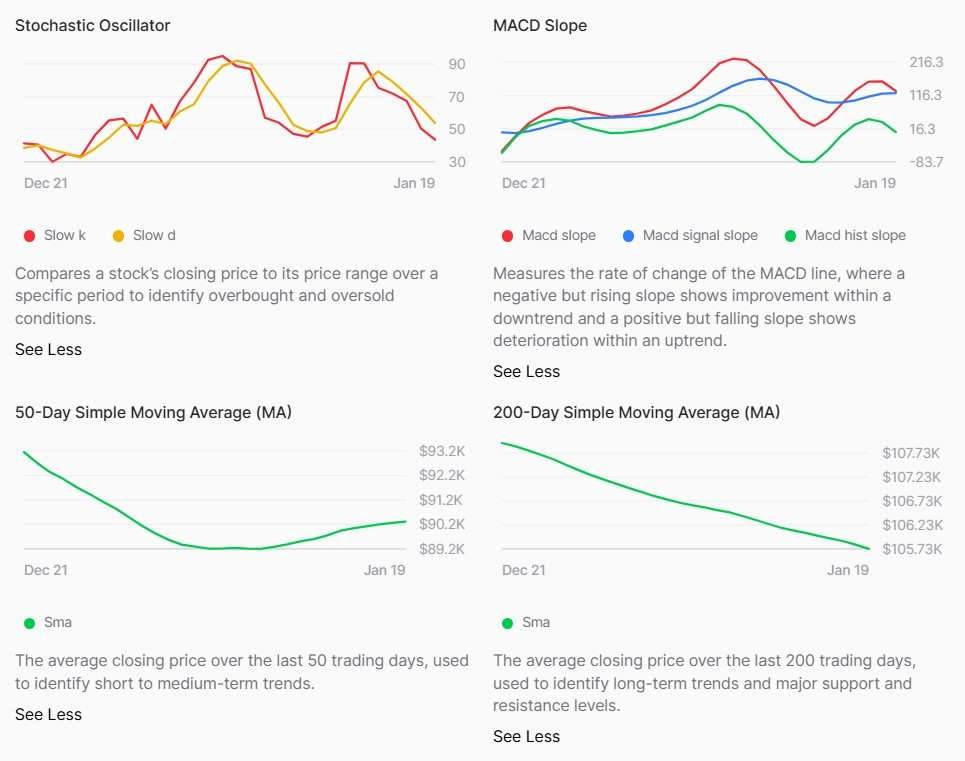
Still, BTC’s relative strength index (RSI) demonstrates that nothing is written in the stars by January 19, as Bitcoin appears neither overbought nor oversold.
Indeed, such a reading further hammers the point that the latest, dramatic price movement was mostly driven by external events – namely, the simmering tensions over President Donald Trump’s desired annexation of Greenland.
Featured image via Shutterstock
Source: https://finbold.com/machine-learning-algorithm-predicts-bitcoin-price-on-january-31-2026/