The conventional wisdom says veteran holders don’t sell into weakness. They accumulate through drawdowns, harvest gains during euphoria, and otherwise sit still while newer cohorts churn.
Late 2025 is testing that model. Across Ethereum, XRP, and pockets of the DeFi stack, dormant whales are moving supply to exchanges as mid-term buyers flee, creating a bifurcated distribution pattern that reveals which assets have genuine cost-basis depth and which remain top-heavy with recent entrants.
Distribution without capitulation
What makes this moment distinct is not the fact of selling, as veterans always rotate, but the timing and composition.
Ethereum whales accumulated 460,000 ETH as the price slid below $3,200 in mid-November, yet Santiment’s Age Consumed metric slowed rather than spiked.
That divergence matters: if fewer very old coins are moving while aggregate whale balances rise, the pressure comes from holders in the three-to-ten-year band trimming positions rather than ICO-era wallets dumping.
Glassnode data shows those mid-duration cohorts selling roughly 45,000 ETH per day, a measured pace that contrasts with the panic-driven spikes seen earlier in the year when both short- and long-term holders exited simultaneously.
XRP tells the opposite story. Dormant Circulation for the 365-day cohort spiked to its highest level since July as whales transferred months-long holdings to Binance, reactivating supply that had been untouched through the prior rally.
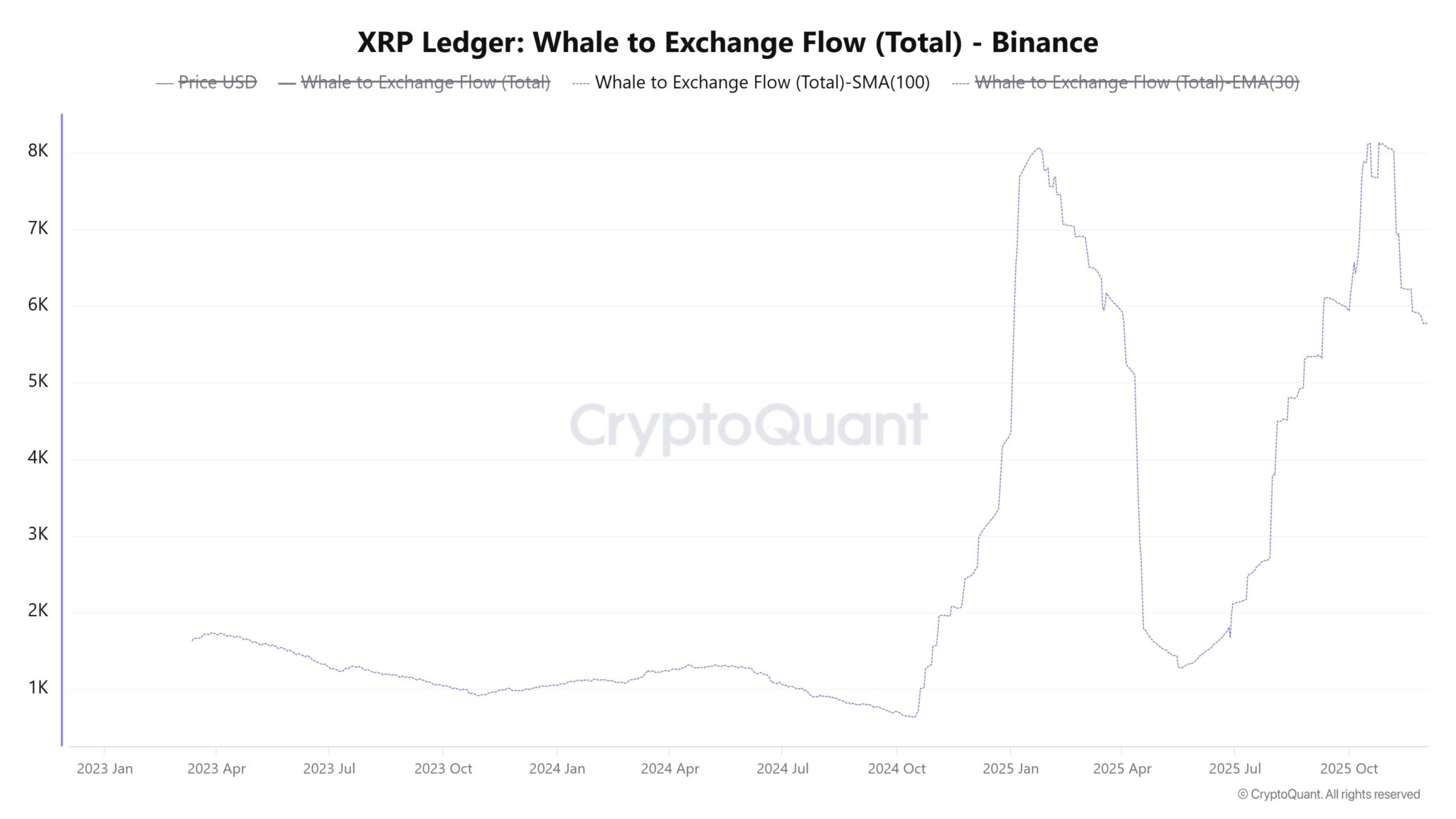
CryptoQuant’s 100-day simple moving average for the Whale-to-Exchange Flow metric peaked on Nov. 6, signaling a multi-month uptrend and suggesting the distribution is structural rather than episodic.
When combined with dormant-supply reactivations across both one-year-plus and three-to-twelve-month bands, the pattern is clear: XRP’s 2025 moves systematically drew out older holders who had waited through consolidation and now see exits as the rational trade.
Although the flow of whale exchanges has subsided, it remains among the highest levels observed in 2025.
The trade-off embedded in these flows is straightforward. Ethereum’s whales are rotating, and older holders are selling into strength as new buyers enter at higher cost bases, building a rising realized cap floor even as the price consolidates.
XRP’s whales are distributing into a market where latecomers already hold most of the realized cap at elevated prices, leaving no absorption cushion if spot demand continues to fade.
Realized cap as the structural tell
Realized cap measures the aggregate cost basis of all coins, weighted by the price at which they last moved. For assets that built genuine cost-basis ladders over multiple cycles, realized cap acts as long-term support.
For assets that printed most of their realized cap in a single blow-off, the structure is brittle: when the top cohort sells, there’s little underneath.
Ethereum’s realized cap was $391 billion as of Nov. 18, according to Santiment, absorbing distribution from older holders via fresh inflows even as price chopped sideways.
That continued accumulation at varied entry points means the network retains cost-basis diversity, short-term holders sit more exposed if another leg down materializes, but veteran cohorts trimming at $3,200 don’t collapse the entire structure because new participants filled the gap at intermediate levels.
XRP’s realized cap nearly doubled from $30 billion to $64 billion during the late-2024 rally, with $30 billion of that coming from buyers who entered in the last six months.
By early 2025, coins younger than 6 months accounted for 62.8% of realized cap, up from 23%, concentrating cost basis at cycle highs. Glassnode’s realized profit-to-loss ratio has trended downward since January, indicating that recent entrants are now realizing losses rather than gains.
When whales send old coins to exchanges in November, reactivating dormant supply at precisely the moment latecomers turn underwater, the realized cap imbalance becomes the central vulnerability.
Dormancy as a leading indicator
Dormancy metrics track when previously idle supply reenters active circulation. Spikes in these indicators don’t automatically signal tops, but rather signal regime change.
When holders who weathered prior cycles decide conditions warrant an exit, their movement often precedes broader distribution because they operate on longer time horizons and larger position sizes than retail cohorts.
Ethereum’s Age Consumed spikes in September and October came from ICO-era wallets finally moving after years of inactivity, but those moves happened into strength rather than panic.
By mid-November, as whales holding 1,000 to 100,000 ETH accumulated over 1.6 million ETH, the Age Consumed metric quieted, meaning the heavy flows were driven by large holders rotating rather than ancient wallets capitulating.
That creates a floor: if the oldest cohorts aren’t selling and mid-term whales are buying, spot absorption can handle measured profit-taking from the three-to-ten-year band.
XRP’s dormancy pattern broke the other way. The 365-day Dormant Circulation hit levels unseen since July, with repeated red spikes as old coins woke up and moved to exchanges.
The reactivations became more frequent as the price struggled to hold above $2, suggesting that holders who sat through the consolidation decided the risk-reward no longer justified their patience.
When dormancy spikes coincide with weakening spot demand and a top-heavy realized cap, the signal is unambiguous: veterans are distributing into a market that can’t absorb it without breaking price support.
Who holds the bag
If Ethereum’s distribution continues at the current pace, three-to-ten-year holders selling 45,000 ETH daily while whales accumulate and realized cap rises, the outcome is a market with higher long-term support but increased short-term volatility.
New entrants at $3,000-$3,500 become the marginal sellers if price breaks lower, while veteran cohorts sit on unrealized gains large enough to weather another drawdown.
If XRP’s dormant-supply reactivations persist while the realized cap remains concentrated among holders with six-month-or-newer holdings, the path narrows.
Each wave of veteran distribution pushes recent buyers further underwater. Because those recent buyers account for the majority of realized cap, their capitulation would collapse the cost-basis floor rather than merely test it.
The risk is self-reinforcing: whales distribute, latecomers sell at losses, realized cap falls, and the next cohort of holders faces an even weaker support structure.
For protocols like Aave, where dormancy data remains sparse, a single address crystalizing $1.54 million in losses by selling 15,396 AAVE into a downtrend signals forced or fear-driven exits from recent entrants, not long-term holders harvesting gains.
When those losses happen while the asset trades below all major moving averages and broader DeFi risk appetite deteriorates, late-cycle capital is exiting rather than rotating.
Who decides the floor
The central question is whether this cycle’s dormant supply reactivations represent healthy rotation, veteran holders exiting at profits while new capital enters at higher bases, or the beginning of a broader deleveraging where top-heavy realized caps collapse under sustained distribution.
Ethereum’s data suggests that older coins are moving. Still, the bulk of recent flow comes from mid-term whales trimming rather than ancient wallets dumping, and rising realized cap confirms fresh money continues to average in.
XRP’s data suggests that dormancy spikes are drawing out one-year-plus holders, while 62.8% of realized cap sits with buyers who entered in the last six months.
The outcome depends on which cohort blinks first. If recent entrants hold and spot demand stabilizes, veteran distribution gets absorbed, and the market builds a higher floor through turnover.
If latecomers capitulate before veteran sellers exhaust themselves, realized cap falls, cost-basis depth evaporates, and the next support level sits far below the current price.
Whales are stirring. Whether that’s a rotation or a rout depends on who’s left to catch what they’re selling.
Source: https://cryptoslate.com/ethereum-xrp-whales-concentration-risk/